
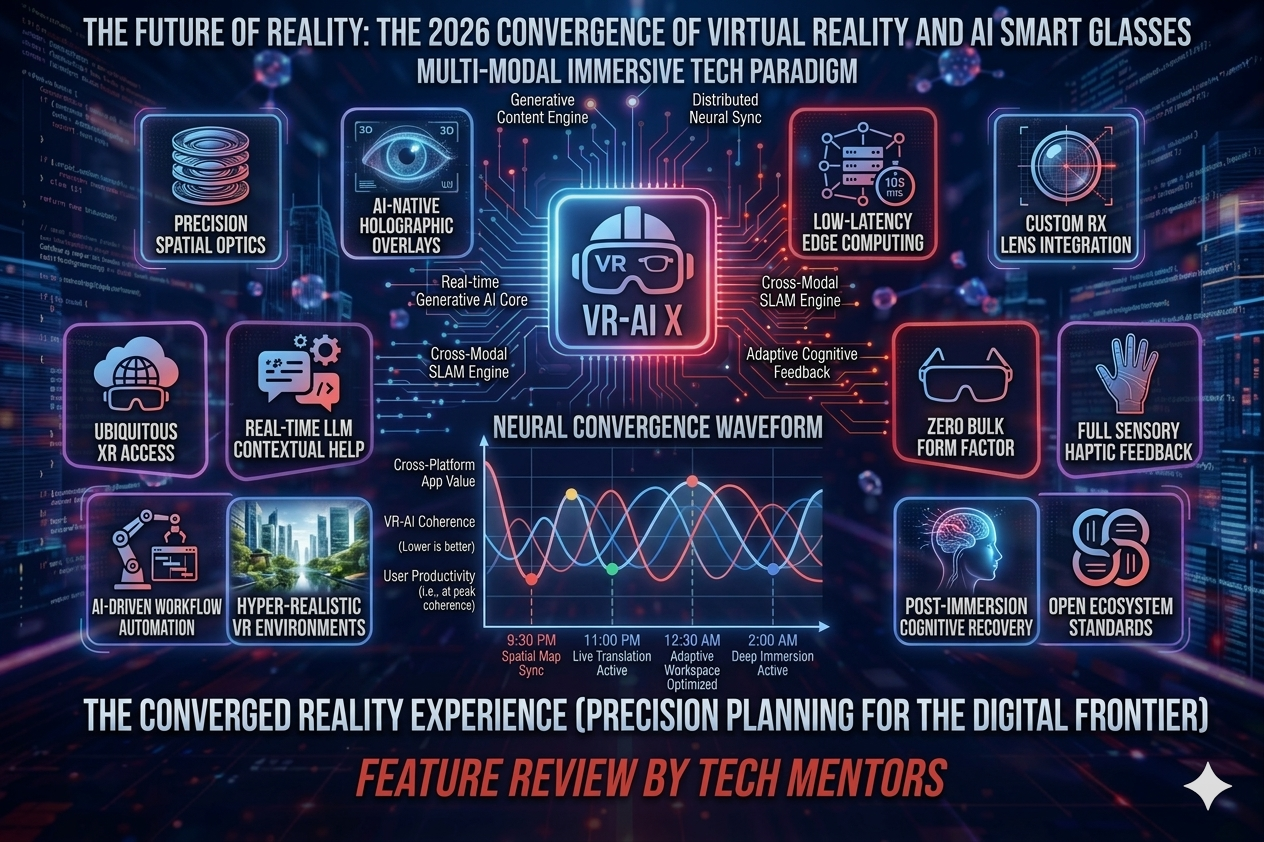
The digital landscape of 2026 has officially transitioned from the “Screen Age” to the “Immersive Age.” For years, we viewed the internet through flat glass rectangles in our pockets. Today, the internet is no longer something we look at; it is something we inhabit. The convergence of Virtual Reality (VR) and AI-integrated Smart Glasses has redefined how we work, play, and communicate, creating a multi-billion dollar ecosystem that blends the physical and digital worlds seamlessly.
1. The Great Shift: From Bulky Gear to Everyday Wear
In the early 2020s, VR was often criticized for being “clunky” and “isolating.” However, 2026 marks the year where hardware limitations have largely vanished.
 The Rise of Standalone Power
Modern headsets like the Meta Quest 4 and the Apple Vision Pro (2nd Gen) have moved toward “pancake optics,” significantly reducing the weight and size of the devices. We now see headsets that are 30% lighter than their predecessors, boasting 4K-per-eye resolution as a standard. This eliminates the “screen door effect,” making digital text as crisp as a printed book.
Smart Glasses: The New Smartphone?
While VR owns the home, Smart Glasses have conquered the outdoors. Devices like the Meta Ray-Ban 2 and Viture Beast XR have proven that consumers prefer “Intelligence over Immersion” for daily tasks. These glasses don’t block your vision; they augment it. With built-in AI assistants that can “see” what you see, these wearables provide real-time translation, turn-by-turn navigation overlays, and facial recognition for professional networking—all while looking like standard fashion eyewear.
2. Generative AI: The Brain Behind the Lens
The real hero of 2026 isn’t just the hardware; it’s the Large Language Models (LLMs) integrated into the frames.
-
Contextual Awareness: If you are looking at a broken engine or a complex recipe, your glasses use multimodal AI to identify the objects and overlay holographic instructions.
-
Real-time Translation: Traveling in 2026 no longer requires a guidebook. Smart glasses can translate foreign street signs instantly or provide live subtitles during a conversation with someone speaking a different language.
-
Generative Engine Optimization (GEO): For marketers and SEO experts, the game has changed. Users now ask their glasses, “Where is the best coffee near me with outdoor seating?” The AI doesn’t show a list of blue links; it highlights the physical path to the shop and displays the menu in mid-air.
3. The Industrial and Professional Revolution
Virtual Reality has moved far beyond gaming. It is now the backbone of the global workforce.
The Virtual Office
With the rise of high-fidelity avatars and spatial audio, “Zoom Fatigue” is a thing of the past. Teams now meet in Persistent Virtual Spaces. An architect in London and a developer in Dubai can walk through a life-sized 3D model of a skyscraper before a single brick is laid.
Training and Healthcare
Surgeons now practice complex procedures in VR simulations that mimic the haptic feedback of human tissue. Similarly, technical workers use AR (Augmented Reality) glasses to receive remote assistance from experts thousands of miles away, seeing “digital annotations” placed directly on the machinery they are fixing.
4. Entertainment: Beyond the Controller
Gaming in 2026 is an athletic and sensory experience. With the integration of haptic suits and omnidirectional treadmills, players are no longer just pressing buttons; they are dodging projectiles and feeling the vibration of virtual environments.
However, the biggest growth has been in Virtual Tourism and Events. Users can now purchase “Virtual Front Row” tickets to a concert or a football match. Using 360-degree 8K cameras, fans feel the energy of the stadium from their living rooms, often with better views than those physically present.
5. Privacy, Ethics, and the “Digital Divide”
As with any revolution, 2026 faces significant challenges regarding data and privacy.
The Privacy Paradigm
With cameras and microphones constantly active on millions of faces, the “Right to be Forgotten” has taken on a new meaning. Manufacturers have responded with mandatory privacy LEDs and encrypted on-device AI processing to ensure that sensitive data never hits the cloud.
The Health Debate
“VR Motion Sickness” is largely solved through high refresh rates (120Hz+), but concerns regarding long-term eye strain and social isolation persist. Experts suggest a “Hybrid Lifestyle”—using Smart Glasses for productivity while ensuring “Unplugged Hours” to maintain a connection with the physical world.
6. Comparison: VR Headsets vs. Smart Glasses
To understand which device fits a user’s life, we must look at the technical trade-offs:
| Feature | High-End VR Headsets | AI Smart Glasses |
| Immersion | Full (100% Digital) | Partial (Augmented) |
| Portability | Home/Office use | All-day wear |
| Primary Input | Hand Tracking/Controllers | Voice/Eye Tracking |
| Battery Life | 2–4 Hours | 8–12 Hours |
| Best For | Gaming, Simulating, Design | Navigation, AI Help, Social |
7. SEO & The Future of Search in 2026
For digital creators, the transition to GEO (Generative Engine Optimization) is vital. Search is no longer about keywords; it’s about intent and proximity.
-
Visual Search: Content must be optimized for “Visual Discovery.” If a user looks at a product through their glasses, the AI should be able to pull up your brand’s review or price comparison.
-
Conversational Content: Since users interact via voice, blog posts and FAQs must be written in a natural, helpful tone that AI agents can easily summarize.
8. Conclusion: A World Without Borders
By the end of 2026, the distinction between “online” and “offline” will be almost non-existent. We are moving toward a Spatial Web, where information is pinned to physical locations.
Virtual Reality and Smart Glasses have not replaced human interaction; they have enhanced it. They allow us to transcend geography, learn skills faster than ever before, and see the world through a lens of infinite information. Whether you are an SEO professional optimizing for the next AI algorithm or a casual user navigating a new city, the glasses on your face are the gateway to a more connected, efficient, and imaginative future.