
In the modern digital age, “hustle culture” often comes at the cost of our most valuable asset: sleep. For SEO specialists, digital creators, and tech professionals, waking up with mental clarity isn’t just a luxury—it’s a performance requirement.
But with so many tools claiming to optimize your rest, which one should you trust? Today, we are breaking down the two heavyweights of sleep optimization: the Manual Sleep Calculator and the AI-driven Sleep Cycle App.
Understanding the Science: The 90-Minute Rule
Before we dive into the tools, we must understand Circadian Rhythm Alignment. Human sleep isn’t a flat line; it moves in waves called “Sleep Cycles.” On average, one cycle lasts 90 minutes, transitioning from Light Sleep to Deep Sleep, and finally to REM (Rapid Eye Movement).
Waking up during Deep Sleep causes Sleep Inertia—that heavy, groggy feeling that can ruin your entire morning. The goal of any sleep tool is to wake you up during the Light Sleep phase.
Tool 1: The Online Sleep Calculator (Precision Planning)
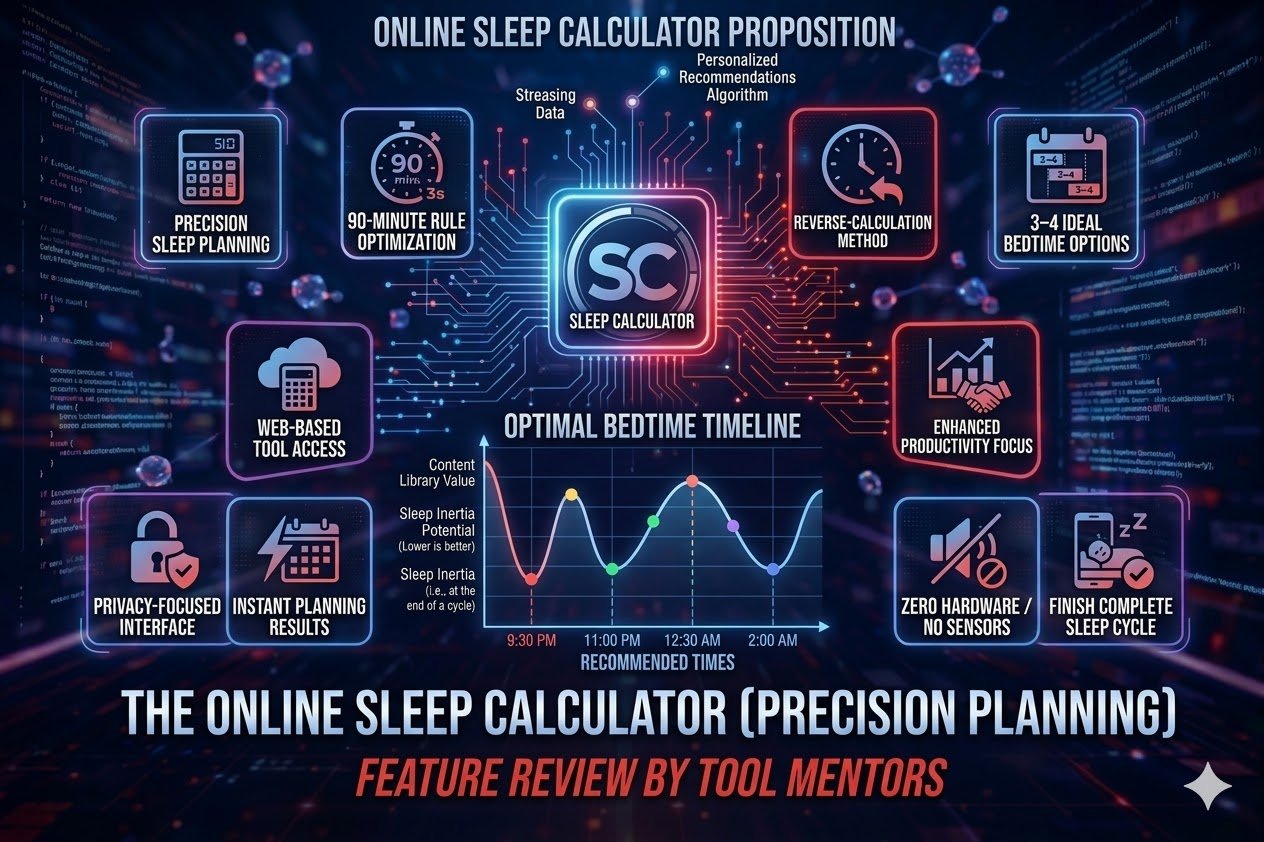
A web-based Sleep Calculator (like the one featured on Tool Mentors) is a mathematical tool designed for those who need to plan their productivity in advance.
How it Works:
It uses reverse-calculation based on the 90-minute rule. You input the time you need to wake up, and it provides 3–4 ideal bedtime options that ensure you finish a complete cycle.
Pros:
-
Zero Hardware Needed: No phone on the bed or sensors required.
-
Instant Planning: Perfect for professionals who need to calculate exactly when to sleep to hit a 6:00 AM deadline.
-
Privacy-Focused: No data tracking or microphone access needed.
Cons:
-
Static Data: It assumes your cycles are exactly 90 minutes, which can vary slightly by person.
Tool 2: The Sleep Cycle App (AI & Sound Analysis)
The Sleep Cycle App represents the high-tech side of sleep optimization, using Acoustic Sleep Tracking to monitor your body’s behavior.
How it Works:
Using your smartphone’s microphone or accelerometer, the app listens for movements and breathing patterns. It identifies which sleep stage you are in and uses a Smart Alarm window (usually 30 minutes) to wake you up at your lightest moment.
Pros:
-
Personalized Data: It learns your specific sleep patterns over time.
-
Detailed Analytics: Provides a “Sleep Quality Score” and tracks snoring or environmental noise.
-
Dynamic Waking: It won’t wake you up at 7:00 AM sharp if you’re in deep sleep; it might wake you at 6:48 AM if you’re already stirring.
Cons:
-
Battery Drain: Requires the phone to be powered and positioned near the bed.
-
Privacy Concerns: Requires microphone/sensor access throughout the night.
Head-to-Head Comparison
| Feature | Sleep Calculator (Tool Mentors) | Sleep Cycle App |
| Method | Mathematical (90-min cycles) | AI Sound/Motion Analysis |
| Ease of Use | High (Instant Result) | Medium (Requires Setup) |
| Cost | Free | Freemium (Paid Subscriptions) |
| Best For | Strategic Planning & Discipline | Long-term Health Tracking |
| Privacy | High (No sensors) | Moderate (Mic/Sensor used) |
The Verdict: Which One Should You Choose?
-
Choose the Sleep Calculator if: You are a disciplined professional who needs a quick, free, and reliable way to plan your night without overcomplicating things. It is the best “get in, get out” tool for peak performance.
-
Choose the Sleep Cycle App if: You struggle with unknown sleep issues, want to track your long-term health trends, and don’t mind having your phone active on your nightstand.
Pro-Tip for Tool Mentors Users: Start with our Sleep Calculator to build a consistent routine. Once you have mastered the 90-minute timing, you can supplement it with an app to fine-tune your environmental data.
Frequently Asked Questions (FAQs)
1. What is the fundamental difference between a Sleep Calculator and a Sleep Cycle app?
A Sleep Calculator is a mathematical tool based on the 90-minute sleep cycle rule, while the Sleep Cycle app uses AI and sensors to track actual physical movements and sleep stages.
2. How does a Sleep Calculator help prevent “Sleep Inertia”?
It predicts when your cycle ends, allowing you to wake up during “Light Sleep,” which feels much more natural than being jerked out of a “Deep Sleep” phase.
3. Is the 90-minute sleep cycle rule accurate for everyone?
While 90 minutes is the average, cycles can vary between 70 and 110 minutes. However, the 90-minute rule remains the most effective baseline for manual planning.
4. How many sleep cycles are recommended for a healthy adult?
Most experts recommend 5 to 6 full sleep cycles, totaling roughly 7.5 to 9 hours of sleep.