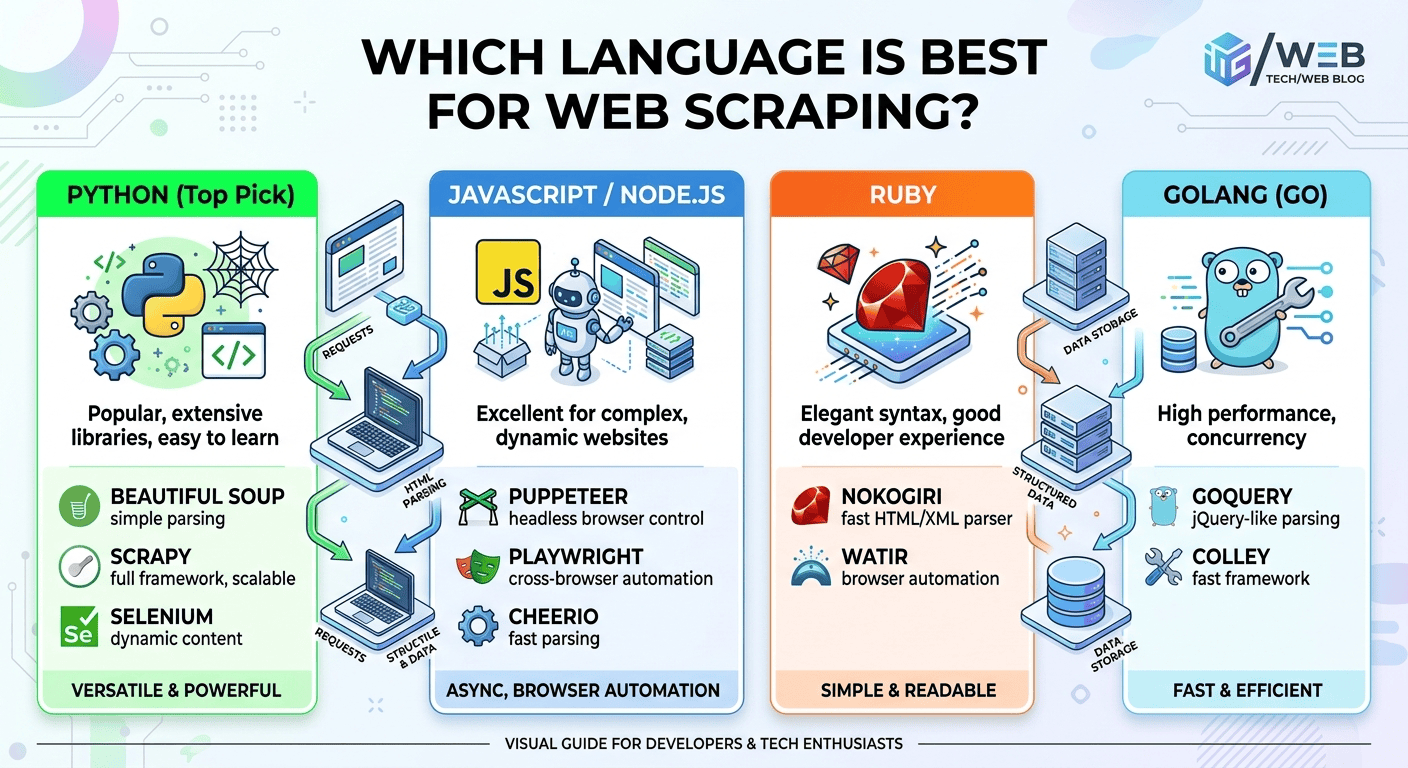
Python is widely considered the overall best language for web scraping due to its massive ecosystem of mature libraries like Beautiful Soup, Scrapy, and Selenium, which handle everything from simple static HTML parsing to complex headless browser automation. However, Node.js serves as the best alternative for heavy JavaScript-rendered single-page applications (SPAs), while Go or C++ excel when ultra-high-performance and concurrent scraping at scale are required.
Which Language Is Best for Web Scraping? A Comprehensive Technical Guide
Web scraping has become an essential pillar for data-driven decisions, machine learning dataset preparation, competitive price intelligence, and market research. Choosing the right programming language determines how quickly you can deploy scrapers, how efficiently your code executes, and how easily you can bypass modern anti-bot mechanisms like Cloudflare, reCAPTCHA, and IP rate limits.
While multiple programming languages offer scraping capabilities, the optimal choice depends on your specific performance requirements, the complexity of the target websites, and your team’s development stack.

1. Python: The Undisputed King of Data Extraction
Python dominates the web scraping industry. It powers over 70% of enterprise and open-source data scraping pipelines thanks to its clean syntax, rapid development cycle, and robust community support.
Key Frameworks & Libraries
-
Beautiful Soup 4: Ideal for beginners and small-scale projects. It parses raw HTML/XML documents into a navigable DOM tree.
-
Scrapy: A powerful, asynchronous, enterprise-grade framework designed to crawl entire domains, handle pipeline transformations, and export data in JSON/CSV formats seamlessly.
-
Selenium & Playwright Python: Headless browser automation tools used to extract dynamic JavaScript-driven content and solve user interaction challenges.
Why Python Wins
-
Minimal Boilerplate: You can write a fully functional HTTP scraper in under 10 lines of code using
requestsandBeautifulSoup. -
Data Integration: Scraped data connects directly into data science libraries like Pandas, NumPy, and PyTorch for immediate cleaning and analysis.
-
Massive Community: Enormous documentation, ready-made middleware for proxy rotation, and active troubleshooting forums.
2. Node.js (JavaScript/TypeScript): Best for Dynamic SPA Web Scraping
Modern web development relies heavily on single-page applications (SPAs) built with React, Vue, and Angular. Node.js excels when scraping these client-side, JavaScript-heavy architectures because it executes natively in the same runtime environment as web browsers.
Key Frameworks & Libraries
-
Puppeteer: Developed by Google, offering precise headless Chrome control for interacting with dynamic content.
-
Playwright Node: Microsoft’s multi-browser automation library built for fast, reliable end-to-end browser interaction.
-
Cheerio: A lightning-fast, lightweight implementation of core jQuery designed specifically for server-side HTML parsing.
Advantages of Node.js
-
Non-Blocking I/O: Asynchronous event loops allow hundreds of HTTP requests to run concurrently without heavy memory overhead.
-
Native DOM Interaction: You can evaluate browser-native JavaScript directly within page contexts without translating logic between languages.
3. Go (Golang): Built for Ultra-High Performance & Concurrency
When your data architecture requires scraping millions of pages daily, interpreted languages like Python can introduce CPU and memory bottlenecks. Go (Golang) provides compiled execution speeds with minimal memory consumption.
Key Libraries
-
Colly: A fast, customizable scraping framework capable of handling thousands of requests per second on a single core.
-
Go Query: Brings jQuery-like syntax and CSS selector parsing to Go applications.
Ideal Use Cases
-
Distributed web crawlers requiring minimal server resource usage.
-
Real-time price aggregation platforms monitoring thousands of e-commerce URLs concurrently.
Comparison Matrix: Scraping Languages at a Glance
| Feature | Python | Node.js (JS/TS) | Go (Golang) | C# / Java |
| Learning Curve | Very Low | Low to Moderate | Moderate | Moderate |
| Development Speed | Extremely Fast | Fast | Moderate | Moderate |
| Parsing Speed | Moderate | Fast | Extremely Fast | Fast |
| Concurrency Model | Asyncio / Multiprocessing | Event Loop (Async/Await) | Goroutines (Native) | Threads / Async |
| Best Ecosystem Tooling | Scrapy, BeautifulSoup | Puppeteer, Playwright | Colly, GoQuery | HtmlAgilityPack, Selenium |
Real-World Benefits for Students, Developers, and Freelancers
Mastering web scraping opens high-value opportunities across tech careers:
-
For Students & Researchers: Automate literature reviews, collect raw datasets for academic papers, and build portfolio projects that showcase end-to-end data pipelines.
-
For Developers: Enhance back-end capabilities by aggregating third-party data APIs, automating repetitive administrative tasks, and mastering asynchronous programming.
-
For Freelancers: Web scraping is one of the highest-demanded freelance skills on Upwork and Fiverr. Businesses regularly pay $300–$1,500+ for custom scraping scripts, lead generation tools, and price-monitoring bots.
Step-by-Step Technical Guide: Building & Deploying an Automated Scraper
Setting up a web scraper requires moving from local development to a stable, cloud-hosted environment that runs 24/7.
[Local Script Development] ➔ [Proxy & User-Agent Setup] ➔ [Cloud Server Deployment] ➔ [Cron Job Scheduler]
Step 1: Write Your Scraper Locally
Use Python with BeautifulSoup or Scrapy to extract structured JSON data from target pages. Test selector robustness against changing layouts.
Step 2: Implement Anti-Bot Evasion Protocols
To avoid IP bans, configure proxy rotation, set custom User-Agent headers, and implement random delays between HTTP requests.
Step 3: Deploy to a Cloud Server
Running scraping bots on a local computer is inefficient. You need a dedicated Virtual Private Server (VPS) with high uptime, fixed bandwidth, and dedicated CPU resources.
For continuous, reliable data extraction, hosting your scrapers on Hostinger VPS Hosting provides ideal infrastructure. Hostinger delivers full root access, dedicated IP options, scalable RAM/NVMe storage, and pre-configured Linux environments (Ubuntu/Debian) designed to keep Python or Node.js workers running smoothly without unexpected drops.
Step 4: Schedule Automation via Cron Jobs
Configure a system task scheduler (cron) on your cloud server to execute your script automatically at set intervals (e.g., every midnight) and stream the parsed output into a cloud database or S3 bucket.
Ready to Deploy Your Web Scrapers on High-Speed Cloud Infrastructure?
To run reliable, 24/7 web scraping bots, headless browser instances, and automated database updates, you need fast, secure, and cost-effective cloud hosting.
Claim an EXCLUSIVE 20% DISCOUNT on Hostinger cloud and VPS hosting solutions to kickstart your web scraping projects today!