
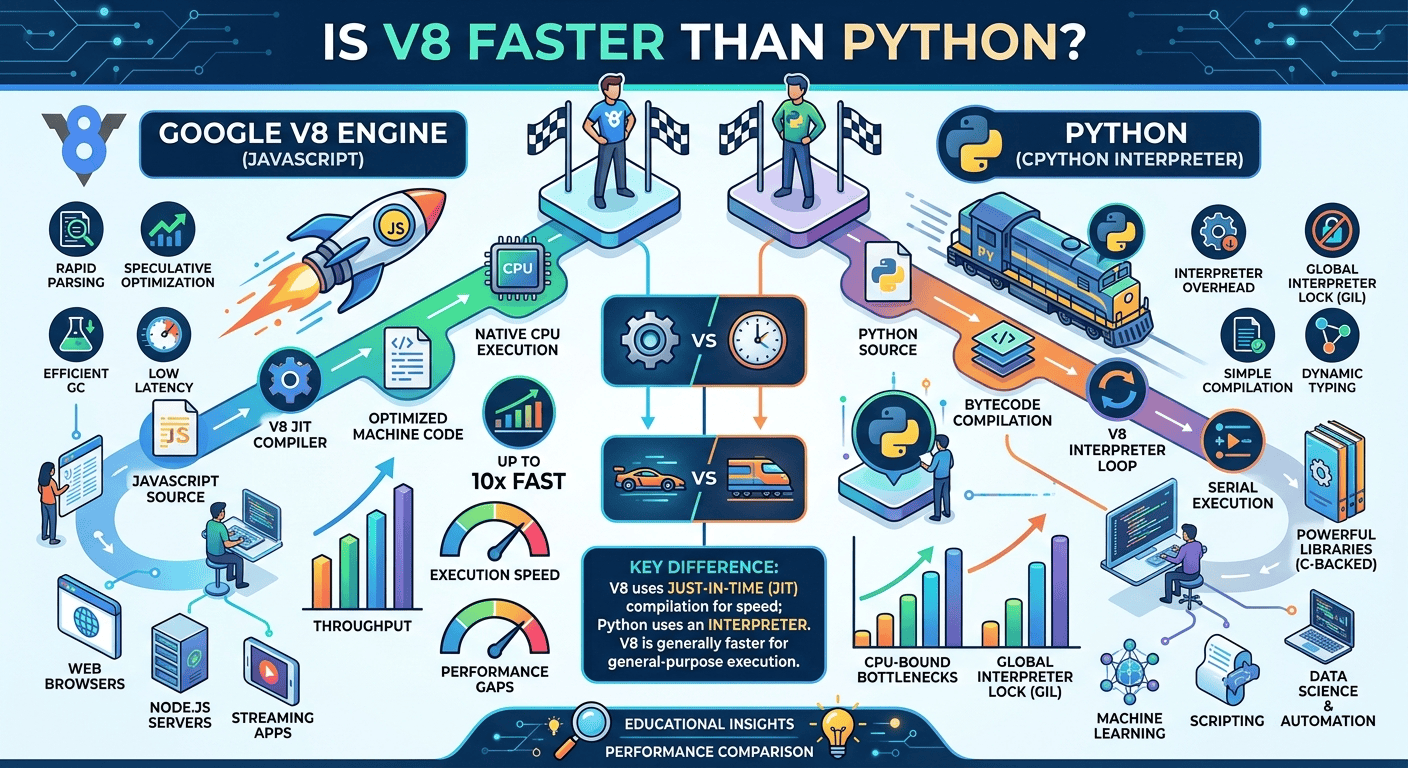
Yes, Google’s V8 JavaScript engine is significantly faster than standard Python (CPython) across most execution benchmarks, primarily due to its advanced Just-In-Time (JIT) compilation architecture. While Python executes bytecode sequentially through an interpreter, V8 compiles JavaScript directly into optimized native machine code at runtime using adaptive optimization pipelines like Ignition and TurboFan.

Is V8 Faster Than Python? A Deep-Dive Technical Comparison
In web development and backend engineering, performance isn’t just a metric—it directly impacts server costs, user experience, and application scalability. When comparing runtime environments, one question frequently arises: Is V8 faster than Python?
The short answer is yes. Google’s V8 engine, which powers Node.js and Chromium-based browsers, substantially outperforms standard Python (CPython) in computational speed, throughput, and asynchronous non-blocking I/O operations.
To understand why V8 holds such a dominant performance edge, we must look beneath the surface at compiler design, memory management, and execution pipelines.

Understanding the Execution Architectures
To compare performance fairly, we must first examine how both environments convert source code into executable instructions.
+-------------------------------------------------------------------+
|                        V8 ENGINE PIPELINE                         |
|  JS Source --> Parser --> AST --> Ignition (Bytecode)              |
|                                         |                         |
|                                         v                         |
|                                  TurboFan JIT Compiler             |
|                                         |                         |
|                                         v                         |
|                                  Optimized Machine Code           |
+-------------------------------------------------------------------+

+-------------------------------------------------------------------+
|                    CPYTHON EXECUTION PIPELINE                     |
|  Python Source --> Parser --> AST --> Bytecode                     |
|                                         |                         |
|                                         v                         |
|                               Python Virtual Machine (PVM)        |
|                                         |                         |
|                                         v                         |
|                               Sequential Interpretation           |
+-------------------------------------------------------------------+
1. Google V8: Just-In-Time (JIT) Compilation Engine
V8 is an open-source, high-performance JavaScript and WebAssembly engine written in C++. Rather than relying on simple interpretation, V8 uses a multi-stage execution pipeline:
-
Ignition Interpreter: Converts JavaScript source code into compact bytecode for fast initial startup.
-
Inline Caching & Hidden Classes: Tracks object shapes dynamically, reducing expensive property lookup times.
-
TurboFan Optimizing Compiler: Identifies frequently executed code (“hot functions”) and re-compiles that bytecode directly into highly efficient machine code target-tailored to the host CPU architecture.
This hybrid JIT design allows JavaScript code to run at speeds approaching compiled languages like C++ or Rust for long-running processes.
2. Standard Python (CPython): Interpreted Virtual Machine
Standard Python uses CPython, an interpreted runtime written in C. When you execute a Python script:
-
The source code is parsed into an Abstract Syntax Tree (AST).
-
The AST is compiled into intermediate Python Bytecode (
.pycfiles). -
The Python Virtual Machine (PVM) evaluates the bytecode sequentially line-by-line inside an evaluation loop.
Because standard CPython lacks a built-in JIT compiler, every instruction must pass through the PVM interpreter loop at execution time, introducing substantial overhead. Additionally, CPython enforces the Global Interpreter Lock (GIL), which prevents multiple native threads from executing Python bytecodes in parallel on multi-core processors.
Detailed Performance Benchmarks & Comparison
| Benchmark Scenario | V8 Engine (Node.js) | Python 3 (CPython) | Performance Winner |
| CPU-Bound Loops | Multi-gigahertz execution via JIT machine code | Interpreted loop execution | V8 (5x to 10x faster) |
| I/O Concurrency | Native non-blocking event loop (libuv) |
asyncio / Thread pools |
V8 (Higher throughput) |
| Memory Startup Overhead | Higher initial footprint (~30–50MB) | Lower initial footprint (~10–15MB) | Python |
| Numeric & Vector Math | High speed, but raw arrays require typed arrays | Native extension support via NumPy/PyTorch | Python (with C extensions) |
Single-Threaded Math & Logic Loops
In synthetic CPU benchmarks—such as calculating Fibonacci sequences, matrix multiplications, or string manipulation loops—V8 typically completes tasks 3x to 10x faster than standard CPython. TurboFan optimizes arithmetic operations by removing type checks once variable types remain stable over multiple iterations.
Concurrent I/O and Network Throughput
Web backends spend most of their life cycle waiting on database queries, network calls, and disk reads. Node.js (built on V8) pairs the engine with libuv, an asynchronous non-blocking event loop.
-
V8 (Node.js): Handles tens of thousands of concurrent connections on a single thread with minimal context switching.
-
Python: Supports async operations via
asyncio, but CPython’s event loop abstraction introduces slightly higher latency and CPU usage under heavy concurrent load.
Why V8 Outperforms Python: Key Technical Drivers
-
Adaptive Dynamic Optimization: V8 continuously profiles running code. If a function is called thousands of times with integers, TurboFan produces specialized machine code for integer operations. If the types change later, V8 gracefully de-optimizes back to Ignition bytecode.
-
Hidden Classes (Shapes): JavaScript uses dynamic objects, which normally makes property lookup slow. V8 assigns internal “hidden classes” to objects with identical structure, transforming costly dictionary lookups into fast offset accesses.
-
Optimized Memory Allocation: V8’s generational garbage collector splits memory into Young and Old generations, scavenging short-lived objects rapidly without long application pauses.
Real-World Benefits for Developers, Students, and Freelancers
Understanding these performance characteristics yields actionable advantages across different career paths:
-
For Freelancers: Delivering fast, low-latency web services using Node.js allows client applications to handle high traffic spikes without requiring expensive high-tier infrastructure immediately.
-
For Students: Mastering V8 and event-driven architecture instills a strong foundational knowledge of asynchronous programming, JIT compilation principles, and runtime optimization.
-
For Full-Stack Developers: Leveraging V8 enables a unified JavaScript/TypeScript tech stack across frontend (React/Vue/Angular) and backend (Node.js/Express/NestJS), reducing context switching and speeding up project deployment.
Note: While V8 excels at raw web application execution, Python remains the undisputed king of Data Science, Machine Learning, and Artificial Intelligence thanks to C-backed libraries like NumPy, Pandas, and PyTorch.
Deploying Performant Applications: Web Hosting Optimization
Even the fastest runtime environment like V8 requires an underlying server architecture that won’t bottleneck hardware resources. Deploying Node.js or Python applications on sluggish hosting leads to high response times regardless of engine efficiency.
Why Server Infrastructure Matters
-
NVMe Storage & IOPS: Fast disk access reduces startup time for Node modules and Python packages.
-
KVM Virtualization: Dedicated CPU cores ensure TurboFan JIT optimizations run without CPU throttling from neighbor tenants.
-
Global Content Delivery & Low Latency: Proximity to users minimizes network round-trip time (RTT).
When setting up production environments for Node.js, Python, or full-stack web applications, Hostinger provides high-speed, cost-effective Virtual Private Server (VPS) hosting optimized for modern runtime workloads.
Maximize Your Application Speed with Hostinger
Ready to launch high-performance Node.js APIs, Python web applications, or modern full-stack projects? You need reliable cloud infrastructure equipped with high-speed NVMe storage, dedicated IPv6/IPv4 addresses, and full root access.
Why Choose Hostinger for Web Hosting?
-
Ultra-Fast Performance: Powered by high-frequency hardware and top-tier NVMe SSD drives.
-
One-Click Deployments: Easily launch Ubuntu, Debian, or AlmaLinux templates pre-configured for Docker, Node.js, and Python.
-
24/7 Global Support: Expert live assistance whenever you need infrastructure guidance.
-
Maximum Security: Built-in DDoS protection, automated backups, and dedicated firewall rules.
Exclusive Limited-Time Offer: Save Up to 20% Extra!
Take your web development projects to the next level today with an EXCLUSIVE 20% DISCOUNT on Hostinger hosting plans.
Click the link below to automatically claim your discount at checkout and start building on world-class infrastructure: