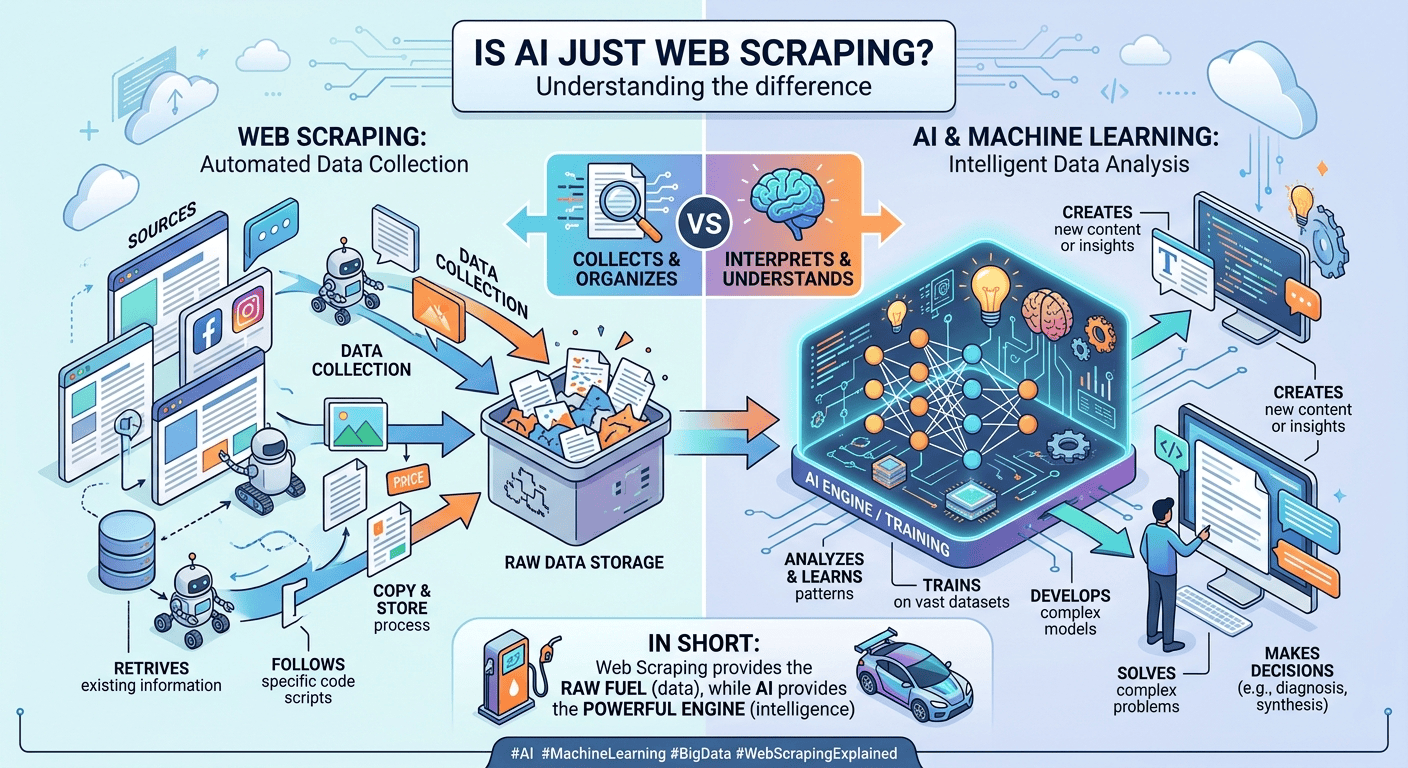
No, AI is not just web scraping; web scraping is merely a data collection mechanism used to gather raw text and media, whereas AI involves complex mathematical architectures—like transformer neural networks—that learn patterns, generalize knowledge, and synthesize original outputs. While web scraping feeds raw information into training datasets, artificial intelligence uses machine learning algorithms, vector embeddings, and inference engines to reason, understand context, and generate new insights far beyond simple data extraction.
Introduction: Decoupling Data Ingestion from Machine Intelligence
With the rapid explosion of Large Language Models (LLMs) like GPT-4, Claude, and Gemini, a common misconception has emerged: Is AI just a glorified, ultra-fast web scraper that copy-pastes information from the internet?
To the untrained eye, an AI chatbot providing an instant answer seems identical to a search engine scraping a website and presenting a snippet. However, from a computer science and backend engineering perspective, comparing web scraping to artificial intelligence is like comparing the process of buying printing paper to writing an original encyclopedia.
Web scraping is a data acquisition method, while artificial intelligence is a cognitive and statistical computation engine. Understanding how these two distinct technologies interact—and where their boundaries lie—is essential for developers, data engineers, and tech enthusiasts building modern automated applications.

Step 1: The Data Pipeline – How Web Scraping Feeds Machine Learning
While AI is not web scraping, AI models—especially LLMs and computer vision systems—heavily depend on web scraping during their initial training phases.
[ Unstructured Web Data ] ──> ( Web Scrapers & Crawlers ) ──> [ Raw Text / Datasets ]
                                                                      │
[ Synthetic Generation ] <── ( Trained AI Model / LLM ) <─── [ Deep Learning Training ]
1. Large-Scale Data Collection
Before a machine learning model can learn language patterns, it requires massive amounts of text. Web crawlers (such as Common Crawl, custom Python Scrapy bots, or headless browser automation tools like Puppeteer and Selenium) sweep billions of publicly accessible web pages, forum threads, open-source repositories, and digital books.
2. Preprocessing, Cleaning, and Tokenization
Raw scraped data is messy. It contains HTML tags, navigation menus, duplicate text, spam, and corrupted code. Before any neural network sees this data, automated data engineering pipelines must:
-
Strip out HTML markup and JavaScript snippets.
-
Remove duplicate web pages and spam entries.
-
Filter out non-linguistic noise and malicious content.
-
Tokenize text into numerical sub-word units that algorithms can process.
Web scraping ends the moment raw data is collected, cleaned, and stored in a database. Everything that happens next belongs strictly to the domain of Artificial Intelligence.
Step 2: From Bytes to Neural Networks – How AI Converts Data into Reasoning
Once web scraping delivers the dataset, deep learning algorithms take over to perform a fundamental transformation: converting static raw text into mathematical weights.
Neural Networks Don’t “Store” Scraped Text
A common myth is that an AI model stores billions of scraped web pages inside a massive internal database and searches through them when you ask a question.
In reality, during the multi-million-dollar training phase, a Transformer-based neural network processes tokens through billions of adjustable parameters (weights). The model does not memorize sentences verbatim; instead, it learns statistical relationships, conceptual structures, grammar rules, and logical patterns.
-
Web Scraper Output: A static SQL database or JSON file containing exact web text.
-
AI Model Output: A compressed mathematical matrix of parameters that understands how concepts relate to one another in multi-dimensional vector space.
Generative Synthesis vs. Information Retrieval
When you query an AI, it does not perform a database lookup or send a web crawler to fetch an answer. It calculates the most statistically coherent and logically sound sequence of tokens based on its internal parameters. This ability to synthesize entirely original code, draft unique essays, or solve complex mathematical problems proves that AI operates on generative reasoning, not scraped retrieval.
Step 3: Retrieval-Augmented Generation (RAG) – Where AI and Scraping Converge
While AI and web scraping are fundamentally different, modern enterprise AI architectures frequently combine both technologies into a hybrid system known as Retrieval-Augmented Generation (RAG).
[ User Query ] ──> [ Real-Time Scraper / Search ] ──> [ Vector Database ]
                                                              │
[ Synthesized Response ] <─── [ LLM Inference Engine ] <──────┘
Standard LLMs have a fixed knowledge cutoff date and can occasionally hallucinate facts. To solve this, developers build RAG pipelines where:
-
A user submits a query to an AI application.
-
A background automated script scrapes real-time data or queries a vector database (e.g., Pinecone, Qdrant, ChromaDB).
-
The scraped contextual snippets are injected into the AI’s prompt window.
-
The AI analyzes the fresh scraped data, synthesizes the facts, and delivers an accurate, real-time response.
In a RAG architecture, the scraper acts as the eyes and ears fetching current external facts, while the AI acts as the brain evaluating, summarizing, and explaining those facts.
Comparing Web Scraping and Artificial Intelligence
| Architectural Feature | Web Scraping | Artificial Intelligence (AI / LLMs) |
| Core Mechanism | HTTP requests, DOM parsing, XPath/Regex extraction | Matrix multiplication, self-attention mechanisms, neural networks |
| Primary Goal | Extracting exact raw data from web pages | Understanding context, reasoning, and generating new outputs |
| Data Storage | Structured databases (PostgreSQL, JSON, CSV) | Mathematical weights and parameters (safetensors, bin files) |
| Output Type | Direct replica of target site content | Original synthesized text, code, images, or predictions |
| Adaptability | Breaks easily when site layouts change | Highly adaptable to unseen prompts and novel tasks |
| Compute Needs | Low CPU/Memory, high network bandwidth | High GPU compute, substantial RAM, specialized inference servers |
Step 4: Deploying Scraping & AI Pipelines on High-Performance Servers
Whether you are running continuous web scrapers using Python’s BeautifulSoup and Celery, or hosting custom open-source AI models (like Llama 3, Mistral, or custom embedding models), deploying these systems on local machines is inefficient.
Production data pipelines and AI microservices require continuous uptime, dedicated CPU/GPU resources, high bandwidth, and complete root terminal control.
This is where a dedicated hosting solution like Hostinger Cloud VPS becomes invaluable. Hostinger provides scalable Linux virtual private servers with fast NVMe storage, unmetered network pipelines, and full root SSH access.
You can host headless scrapers running 24/7 on Ubuntu, run Dockerized vector databases, host API microservices using FastAPI, and seamlessly connect your scraping pipelines to custom AI models—all on a stable, high-speed cloud infrastructure.
Real-World Applications & Benefits for Tech Professionals
Understanding the distinction and synergy between web scraping and AI gives developers, students, and freelancers a significant competitive edge:
-
For Students & Academics: Learn to build sophisticated data science pipelines by pairing automated data collection with predictive machine learning models rather than treating AI as a black box.
-
For Software Developers: Architect resilient microservices by delegating data retrieval to asynchronous background workers and complex logic to specialized LLM API endpoints.
-
For Freelancers & Consultants: Monetize high-value client automation packages—such as automated real-time competitor price monitoring, sentiment analysis dashboards, or domain-specific customer support bots.
Best Practices for Building Hybrid AI & Scraping Architectures
When combining web scraping with AI models in production, follow these key engineering practices:
-
Respect Web Scraper Ethics: Always check
robots.txtfiles, implement rate limiting, and use asynchronous request throttling to avoid overloading target web servers. -
Sanitize Inputs Before Prompting: Raw scraped text can contain prompt injection attacks or invisible malicious code. Always clean scraped HTML before feeding it into an AI context window.
-
Use Asynchronous Task Queues: Separate your scraping workers from your AI inference workers using tools like Redis and Celery so slow network requests do not block model execution.
-
Implement Efficient Vector Caching: Store generated text embeddings in dedicated vector databases to avoid re-embedding identical scraped text, saving significant computational cost.
Elevate Your AI & Scraping Infrastructure with Hostinger Cloud VPS
Building high-performance web scrapers, training custom machine learning models, or hosting continuous RAG pipelines requires a fast, dependable, and cost-effective cloud environment.
Hostinger VPS delivers dedicated system resources, lightning-fast NVMe SSD storage, enterprise-grade security, and full root SSH access—giving you complete freedom to configure Python environments, Docker containers, vector databases, and background process managers like systemd or PM2.
Exclusive 20% Discount Offer
Take your web scraping and AI engineering projects to the cloud today with an EXCLUSIVE 20% DISCOUNT on Hostinger VPS hosting plans.
-
Full Root Terminal Access & Custom OS Deployment
-
99.9% Uptime Guarantee for Continuous Data Scraping
-
Ultra-Fast NVMe Storage & High-Bandwidth Network Pipelines
-
Instant Server Snapshots & Automated Backups