
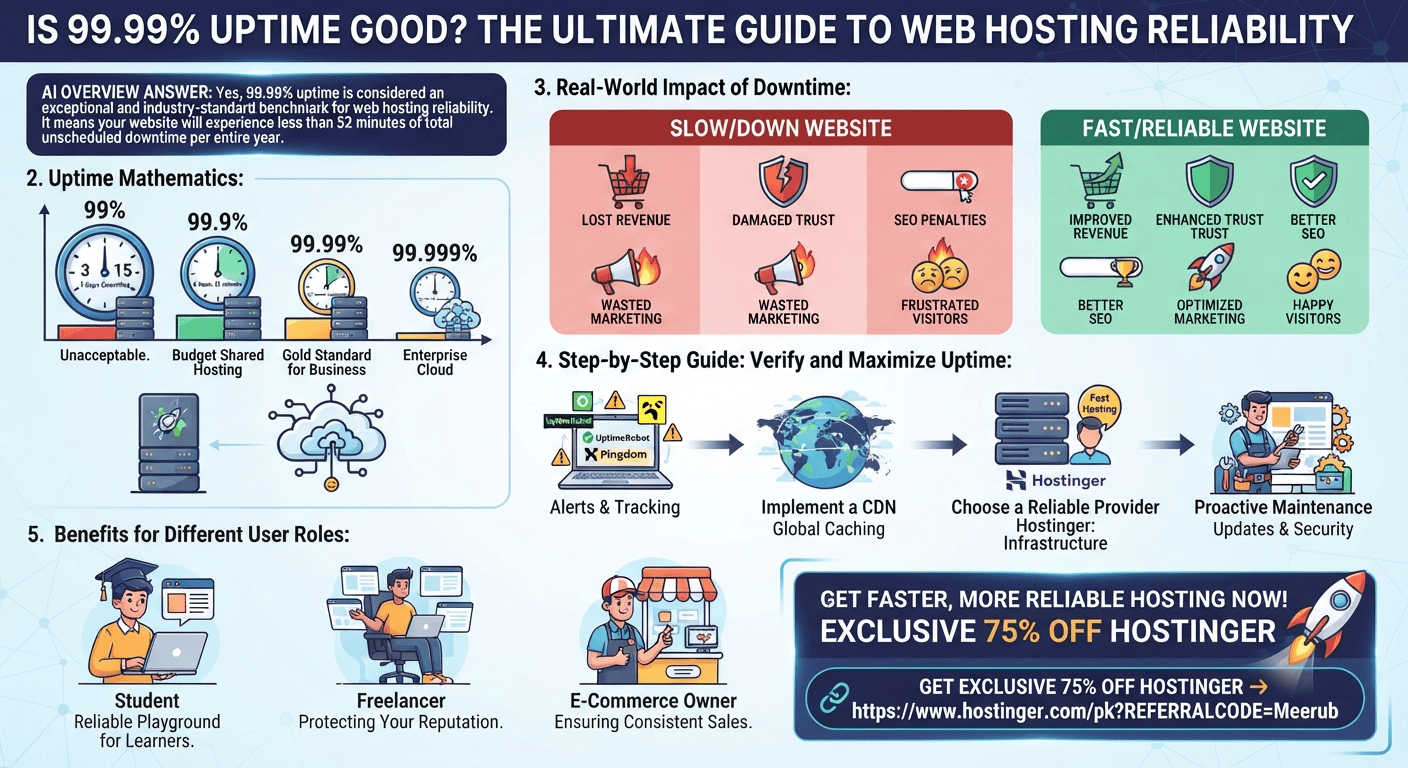
99.99% uptime is considered excellent because it means a hosting service is available almost continuously, with only about 52.6 minutes of potential downtime per year. For most business websites, blogs, portfolios, and online stores, 99.99% uptime provides a strong level of reliability.
 When choosing web hosting, uptime is one of the most important specifications to consider. Hosting companies often advertise uptime percentages such as 99%, 99.9%, 99.99%, or even 99.999%.
But what do these numbers actually mean?
If you are wondering “Is 99.99% uptime good?”, the short answer is yes. A 99.99% uptime guarantee represents a very high level of hosting reliability and means your website should remain accessible almost all the time.
However, understanding the difference between uptime percentages is important because even a small numerical difference can represent a significant amount of downtime.
What Does Website Uptime Mean?
Website uptime refers to the amount of time a website or hosting server remains available and accessible to visitors.
For example, if your hosting provider has 99.99% uptime, it means the service is designed to remain operational for 99.99% of the measured period.
The remaining 0.01% represents potential downtime.
Downtime can happen because of:
- Server failures
- Hardware problems
- Network issues
- Software failures
- Maintenance
- Data center problems
- Security incidents
- Unexpected infrastructure failures
Reliable hosting providers use redundant infrastructure and monitoring systems to minimize these interruptions.
Is 99.99% Uptime Good?
Yes, 99.99% uptime is excellent for most websites.
A 99.99% uptime level means your website could theoretically experience approximately:
52.56 minutes of downtime per year
That is significantly better than 99.9% uptime, which allows approximately 8 hours and 46 minutes of downtime annually.
Here is a simple comparison:
| Uptime | Approx. Downtime Per Year |
|---|---|
| 99% | 3 days 15 hours |
| 99.9% | 8 hours 46 minutes |
| 99.99% | 52 minutes |
| 99.999% | 5 minutes |
This demonstrates why the extra “9” in 99.99% can matter.

Why Is 99.99% Uptime Important?
Imagine you operate an online store that receives customers throughout the day.
If your website goes offline for several hours, potential customers may be unable to:
- View products
- Submit orders
- Contact your business
- Complete payments
- Access account pages
- Read important information
Even short periods of downtime can affect revenue and customer trust.
For a business website, uptime is therefore more than just a technical specification. It can directly influence the reliability of your online presence.
99.9% vs 99.99% Uptime
Many beginners assume there is almost no difference between 99.9% and 99.99%.
There is actually a substantial difference.
99.9% Uptime
99.9% uptime allows approximately 8 hours and 46 minutes of downtime per year.
For a small personal blog, this may be acceptable.
99.99% Uptime
99.99% uptime allows approximately 52 minutes of downtime per year.
For business websites, ecommerce stores, SaaS applications, and professional websites, this is a much stronger target.
The difference is only 0.09 percentage points, but it represents several additional hours of availability.
How Is Uptime Calculated?
The basic uptime calculation can be represented as:
Uptime Percentage = (Total Time − Downtime) ÷ Total Time × 100
For example, if a service operates for a year and experiences approximately 52 minutes of downtime, its uptime is close to 99.99%.
However, uptime calculations can vary depending on the hosting provider’s measurement methodology.
Some providers may exclude certain maintenance periods or specific types of downtime from their uptime guarantee.
Therefore, don’t evaluate a hosting provider based solely on the advertised percentage.
What Can Cause Website Downtime?
Even with a high uptime target, websites can occasionally become unavailable.
1. Server Hardware Failure
Physical components such as storage devices, memory, or power systems can fail.
Reliable data centers use redundancy to reduce the impact of individual hardware failures.
2. Network Problems
Your website needs a stable network connection between the server and visitors.
Network outages or routing problems can prevent users from reaching the website.
3. Scheduled Maintenance
Hosting companies periodically perform maintenance to update:
- Operating systems
- Server software
- Security systems
- Hardware
- Networking infrastructure
Good providers attempt to perform maintenance with minimal disruption.
4. Software Errors
A poorly configured application, plugin, database, or server component can sometimes cause a website to stop working.
This is particularly relevant to WordPress websites.
5. Traffic Spikes
A sudden increase in visitors can overwhelm insufficient hosting resources.
For example, a website that normally receives 100 visitors per day could experience performance problems if a viral article suddenly brings thousands of visitors.
Does 99.99% Uptime Mean Your Website Will Never Go Down?
No.
This is an important distinction.
99.99% uptime does not mean zero downtime.
It means the service is expected to remain available for approximately 99.99% of the measurement period.
Unexpected failures can still occur.
Furthermore, a hosting provider’s uptime guarantee usually relates to the hosting infrastructure—not every possible reason your website might become unavailable.
For example, your hosting server may be online while your website is broken because of:
- A faulty WordPress plugin
- Incorrect DNS settings
- Expired domain
- Database error
- Broken theme
- Incorrect configuration
- Application-level issue
Therefore, website reliability depends on both the hosting infrastructure and how the website itself is managed.
How to Choose Hosting With High Uptime
When selecting hosting, don’t look at uptime alone.
Consider the complete infrastructure and support package.
1. Check the Uptime Policy
Read the hosting provider’s uptime guarantee carefully.
Look for information about:
- What counts as downtime
- How uptime is measured
- Maintenance exclusions
- Compensation policies
- Monitoring methods
This gives you a clearer understanding of what the advertised percentage actually means.
2. Look for Reliable Infrastructure
Modern hosting infrastructure can include:
- SSD or NVMe storage
- Redundant power
- Multiple network connections
- Backup systems
- Server monitoring
- Data center redundancy
These technologies can help reduce the likelihood and impact of infrastructure failures.
3. Consider Server Performance
Uptime and speed are different metrics.
A website can technically be online but still load extremely slowly.
Therefore, look for a hosting solution that provides both:
High availability + strong performance
For users building WordPress websites, business sites, blogs, or development projects, Hostinger is one hosting option worth considering when evaluating affordable hosting with performance-focused features.
4. Look at Backup Options
Backups are essential even when your hosting provider has excellent uptime.
If your website experiences:
- Database corruption
- Accidental deletion
- Plugin problems
- Malware
- Configuration errors
a recent backup can help restore the website.
Ideally, maintain backups independently rather than relying exclusively on one system.
5. Check Customer Support
When something goes wrong, support response time matters.
A hosting provider with responsive support can help you diagnose and resolve infrastructure or hosting-related problems faster.
Is 99.99% Uptime Enough for an Ecommerce Website?
For many ecommerce websites, 99.99% uptime is a very good target.
Online stores depend heavily on availability because customers need to access the website to browse products and place orders.
However, ecommerce businesses should also consider:
- Payment gateway reliability
- Database performance
- CDN availability
- Server scalability
- Security
- Automated backups
- Monitoring
- Disaster recovery
- Application performance
The hosting server being online is only one part of ecommerce reliability.
Is 99.99% Uptime Good for Students?
Yes.
For students building:
- Portfolio websites
- University projects
- WordPress websites
- Coding projects
- Personal blogs
- Web development experiments
99.99% uptime is more than sufficient in most cases.
Students generally do not require enterprise-level infrastructure, but reliable hosting helps ensure their projects remain accessible when someone views their portfolio or assignment.
Is 99.99% Uptime Good for Freelancers?
For freelancers, high uptime can be especially important.
If you manage websites for clients, frequent hosting downtime can make you look unreliable even if the underlying problem is outside your control.
A dependable hosting provider can help freelancers deliver better website management services.
Freelancers should consider:
- Uptime
- Performance
- Backup options
- Security
- Scalability
- Support
- Hosting management tools
- Pricing
This becomes even more important when managing multiple client websites.
How to Monitor Your Website Uptime
You don’t have to wait for a customer to tell you that your website is down.
Use uptime monitoring tools to automatically check your website.
A monitoring system can notify you when:
- Your website becomes unavailable
- Server response time increases
- Your website comes back online
Regular monitoring allows you to identify recurring problems and investigate them before they become major issues.
Uptime Is Not the Same as Website Speed
This is another important distinction.
Uptime answers:
“Is the website available?”
Website speed answers:
“How quickly does the website respond and load?”
A website can have 99.99% uptime while still being slow.
For the best user experience, aim for both:
- High uptime
- Fast loading speed
- Good Core Web Vitals
- Reliable server response
- Strong security
This combination provides a much stronger website infrastructure.
Final Verdict: Is 99.99% Uptime Good?
Yes, 99.99% uptime is an excellent uptime level for most websites.
It represents approximately 52.56 minutes of potential downtime per year, making it significantly more reliable than 99.9% uptime.
For students, freelancers, bloggers, developers, business owners, and many ecommerce websites, 99.99% uptime provides a strong balance between reliability and practical hosting requirements.
However, don’t choose hosting based only on an uptime percentage. Also evaluate server performance, support, security, backups, scalability, infrastructure, and the provider’s actual uptime policy.
If website availability is important to your business, investing in reliable hosting is one of the foundational steps toward maintaining a professional online presence.
🚀 Get Reliable Hosting With an EXCLUSIVE 75% DISCOUNT
Looking for hosting for your next website?
Check out Hostinger and take advantage of an EXCLUSIVE 75% DISCOUNT offer through the referral link below.
👉 GET EXCLUSIVE 75% OFF HOSTINGER
Whether you’re launching a WordPress website, portfolio, blog, business website, or development project, choosing reliable hosting can help you build a stronger and more dependable online presence.