However, Flutter uses Dart and its own rendering engine, while React Native uses JavaScript or TypeScript and renders native platform components. These differences affect how applications are designed, developed, maintained, and optimised.
In this comprehensive ToolMentors guide, we will compare Flutter vs React Native from beginner to advanced levels. You will learn how both frameworks work, explore their advantages and disadvantages, compare performance and development costs, and discover which framework is better for different types of mobile applications.
1. SEO Metadata
Article Topic: Flutter vs React Native: Which Is Better for App Development?
SEO Title: Flutter vs React Native: Which Is Better in 2026?
Meta Description: Compare Flutter vs React Native in 2026. Explore performance, features, costs, UI design, development tools, and which framework to choose.
URL Slug: flutter-vs-react-native
Primary Focus Keyword: Flutter vs React Native
Search Intent: Informational and commercial investigation. Readers want to compare both frameworks and decide which technology is suitable for their mobile app projects.
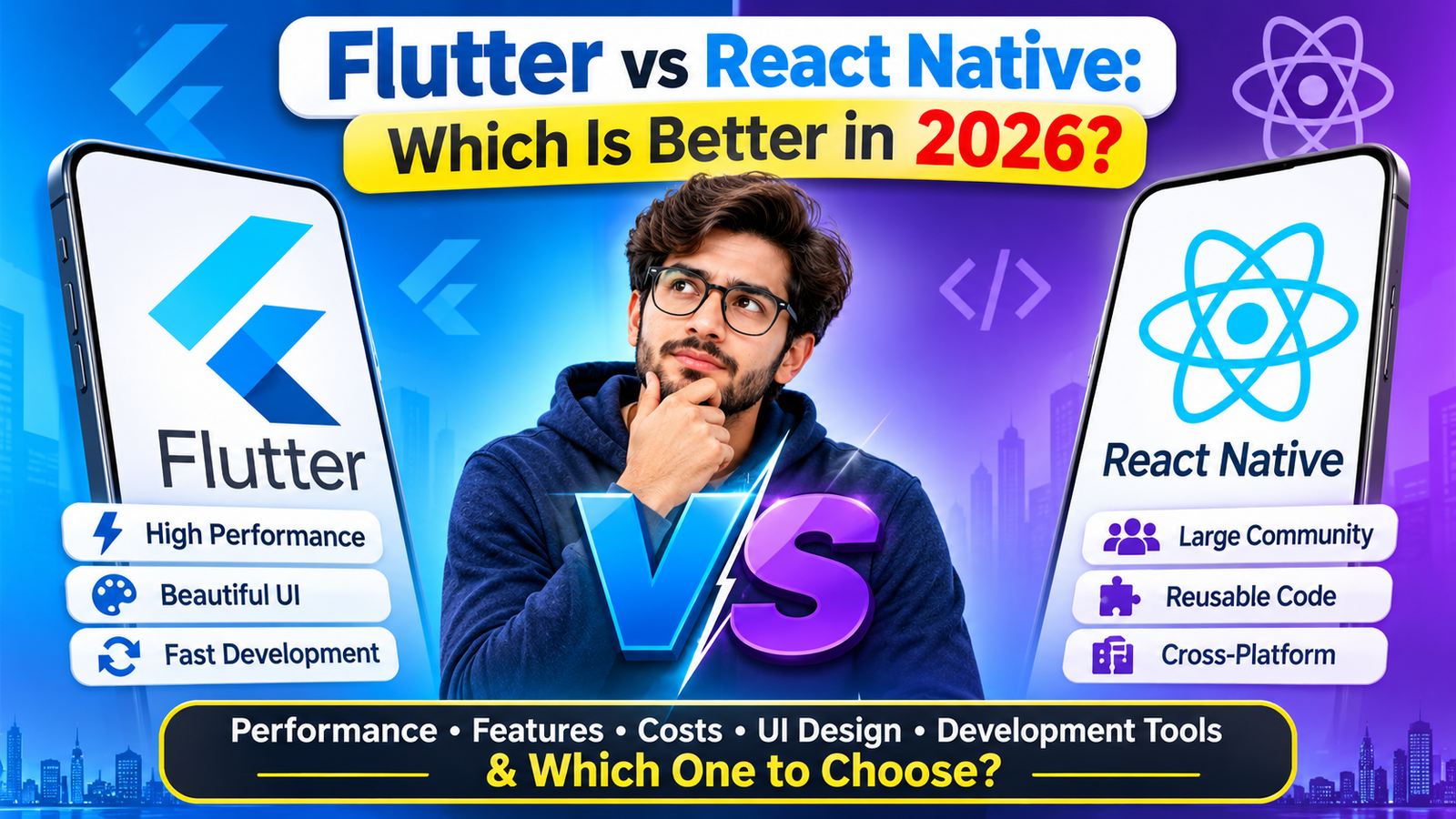
Featured Image
-
Featured Image Title: Flutter vs React Native App Development Comparison
-
ALT Text: Flutter vs React Native comparison showing mobile app development frameworks, programming languages, and Android and iOS applications.
2. SEO Keyword Research – Exactly 10 Keywords
|
Category |
SEO Keyword |
|---|---|
|
Primary |
Flutter vs React Native |
|
Secondary 1 |
Flutter vs React Native performance |
|
Secondary 2 |
Flutter vs React Native comparison |
|
Secondary 3 |
Best framework for app development |
|
Long-tail 1 |
Which is better Flutter or React Native |
|
Long-tail 2 |
Flutter vs React Native for beginners |
|
Long-tail 3 |
Should I learn Flutter or React Native |
|
Semantic 1 |
Cross-platform mobile app development |
|
Semantic 2 |
Dart vs JavaScript |
|
Semantic 3 |
Native mobile app development |
These keywords will be incorporated naturally throughout the article, including its headings, explanations, comparison tables, and frequently asked questions.
Flutter vs React Native: Which Is Better for App Development?
3. What Is Flutter?
Understanding the first framework

Flutter is an open-source user interface development framework created by Google. It allows developers to build applications for Android, iOS, web, desktop, and other supported platforms using a shared codebase.
Flutter uses Dart as its primary programming language. Instead of relying entirely on the operating system’s standard interface components, Flutter uses its own rendering system to draw application interfaces.
This approach gives developers considerable control over how their applications look and behave across different devices.
How Does Flutter Work?
Flutter follows a widget-based architecture. Almost everything visible in a Flutter application is represented by a widget.
For example:
-
Text labels are created using text widgets.
-
Buttons are created using button widgets.
-
Layouts are organised using row and column widgets.
-
Images are displayed through image widgets.
-
Complete application screens are constructed by combining smaller widgets.
Flutter uses its rendering engine to draw these interface elements. Its modern Impeller renderer helps provide predictable graphics rendering and smooth animations on supported platforms.
A simplified Flutter development process looks like this:
-
Write application code using Dart.
-
Create the interface using Flutter widgets.
-
Manage application state and user interactions.
-
Connect APIs, databases, and device features.
-
Test the application on Android and iOS.
-
Build and deploy the application.
Main Features of Flutter
1. Single codebase
Developers can reuse a substantial amount of code across Android and iOS applications.
2. Hot reload
Hot reload allows developers to see many code changes quickly without restarting the entire application or losing the current application state.
3. Customisable interface
Flutter provides extensive control over colours, animations, layouts, typography, and interface components.
4. Cross-platform support
Flutter supports mobile, web, and desktop development.
5. Rich widget library
Developers can use Material Design and Cupertino widgets to create Android-style and Apple-style interfaces.
6. Strong development tools
Flutter works with popular development environments, including Visual Studio Code and Android Studio.
Advantages of Flutter
-
Excellent control over custom application designs.
-
Consistent appearance across different operating systems.
-
Reusable widgets and components.
-
Strong support for animations.
-
Hot reload for faster development.
-
Suitable for applications targeting multiple platforms.
-
One main programming language for the application code.
Disadvantages of Flutter
-
Developers need to learn Dart.
-
Its ecosystem is smaller than the wider JavaScript ecosystem.
-
Flutter applications include their rendering engine, which can increase application size.
-
Some third-party libraries may not provide complete platform support.
-
Certain native features require platform-specific integrations.
-
Flutter web is not always the best choice for content-heavy, search-driven websites.
Who Should Choose Flutter?
Flutter is particularly suitable for:
-
Beginners starting mobile app development without an existing JavaScript background.
-
Startups developing applications for Android and iOS.
-
Businesses requiring consistent interfaces.
-
Developers building highly customised applications.
-
Projects involving complex animations.
-
Teams planning to reuse application code across mobile and desktop platforms.
If you want to understand Flutter installation, widgets, Dart programming, state management, and practical app development, explore our complete Flutter app development guide.
4. What Is React Native?

React Native is an open-source mobile application development framework originally created at Meta.
It allows developers to create Android and iOS applications using JavaScript or TypeScript with the React programming model.
Unlike Flutter, React Native primarily uses native platform components to display application interfaces. This means that common interface elements are represented by corresponding native components on the operating system.
For example, a React Native View is rendered using the appropriate native view on Android or iOS.
This approach helps applications follow the design conventions and behaviours of their target platforms.
How Does React Native Work?
React Native uses a component-based architecture.
Developers create reusable components that represent different parts of an application interface.
For example:
-
View creates layout containers.
-
Text displays written content.
-
TextInput accepts user input.
-
Pressable handles touch interactions.
-
Image displays images.
-
ScrollView supports scrolling content.
JavaScript or TypeScript controls application logic, while React Native connects the application to native platform functionality through its modern architecture.
Its New Architecture includes important technologies such as:
-
Fabric: The rendering system responsible for managing native user interfaces.
-
JSI: JavaScript Interface, which enables more direct communication between JavaScript and native code.
-
Turbo Native Modules: A system for accessing native functionality more efficiently.
-
Hermes: A JavaScript engine optimised for React Native applications.
These technologies have improved the framework’s architecture and reduced limitations associated with its older bridge-based implementation.
Main Features of React Native
1. JavaScript and TypeScript support
Developers can use familiar programming languages to create mobile applications.
2. React component architecture
Reusable components make application interfaces easier to organise and maintain.
3. Native interface components
Applications use native platform views rather than relying on a completely separate custom rendering system.
4. Fast Refresh
Fast Refresh allows developers to see many code changes quickly during development.
5. Large JavaScript ecosystem
Developers can access a broad collection of JavaScript libraries and development packages.
6. Expo support
Expo provides additional tools and services that simplify React Native development, testing, building, and deployment.
7. Native functionality
Applications can integrate device capabilities such as cameras, location services, notifications, and sensors through suitable native modules and libraries.
Advantages of React Native
-
JavaScript and TypeScript are widely used programming languages.
-
Easier transition for developers familiar with React.
-
Large package ecosystem.
-
Reusable application components.
-
Access to native Android and iOS functionality.
-
Fast Refresh improves the development experience.
-
Expo simplifies many development tasks.
-
Useful for organisations with existing React development teams.
Disadvantages of React Native
-
Developers may need to understand native Android and iOS development.
-
Some libraries require additional configuration.
-
Native dependencies can create compatibility problems.
-
Platform-specific adjustments may be necessary.
-
Complex custom graphics may require additional implementation.
-
Dependency management and framework upgrades require attention.
Who Should Choose React Native?
React Native is a strong option for:
-
JavaScript developers.
-
React developers entering mobile development.
-
Startups with limited development resources.
-
Businesses with existing React web applications.
-
Freelancers building mobile applications for clients.
-
Teams that want to use TypeScript across their technology stack.
For a practical introduction to its components, navigation, APIs, and application deployment, read our React Native app development guide.
5. Flutter vs React Native: Key Differences
Now that we understand both frameworks, let’s examine their most important technical differences.


Flutter vs React Native Comparison Table
|
Feature |
Flutter |
React Native |
|---|---|---|
|
Original creator |
|
Meta |
|
Programming language |
Dart |
JavaScript or TypeScript |
|
Architecture |
Widget-based |
Component-based |
|
UI rendering |
Own rendering engine |
Native platform components |
|
Main mobile platforms |
Android and iOS |
Android and iOS |
|
Web support |
Built-in |
Through React Native Web and related tooling |
|
Desktop support |
Windows, macOS, Linux |
Through related platform projects |
|
UI consistency |
Highly consistent |
More platform-oriented |
|
Development experience |
Hot reload |
Fast Refresh |
|
Ecosystem |
pub.dev |
npm |
|
Native integration |
Platform channels and plugins |
Native modules and libraries |
|
Custom animations |
Excellent control |
Supported through libraries and native capabilities |
|
Learning requirement |
Dart and Flutter |
JavaScript/TypeScript and React |
|
Best suited for |
Custom interfaces and multi-platform apps |
React-based teams and native-style interfaces |
The most important distinction is the way both frameworks build their user interfaces.
Flutter controls its own rendering, while React Native connects application components to native platform views.
This architectural difference influences interface consistency, native integration, development workflows, and some performance characteristics.
Dart vs JavaScript: Which Language Is Better?
Flutter uses Dart, whereas React Native uses JavaScript or TypeScript.
Both approaches can support professional mobile application development.
|
Comparison |
Dart |
JavaScript |
|---|---|---|
|
Main framework |
Flutter |
React Native |
|
Typing |
Statically typed |
Dynamically typed |
|
Type safety |
Built into the language |
Optional through TypeScript |
|
Syntax |
Similar to several C-style languages |
Familiar to web developers |
|
Web development |
Supported through compilation |
Widely used |
|
Learning advantage |
Good for structured programming |
Excellent for existing web developers |
|
Ecosystem |
Dart and Flutter packages |
Extensive JavaScript ecosystem |
Dart provides features such as sound null safety and ahead-of-time compilation for production mobile builds.
JavaScript offers a much wider ecosystem and is particularly convenient for developers already working with React.
TypeScript adds static type checking to JavaScript projects, making it useful for larger applications.
Verdict: JavaScript is generally easier to adopt if you already develop websites with React. Dart is an approachable option if you want to concentrate on Flutter and its development ecosystem.
6. Flutter vs React Native Performance
Performance is one of the most important considerations when selecting a mobile development framework.
An application should open quickly, respond to user interactions, display animations smoothly, and manage memory efficiently.
However, it is incorrect to assume that one framework will always be faster than the other.
Both Flutter and React Native can deliver excellent performance when developers follow appropriate coding and optimisation practices.
Flutter Performance
Flutter uses Dart and compiles production mobile applications ahead of time into native machine code.
Its rendering engine provides control over how graphical elements are displayed.
Flutter can be particularly effective for:
-
Complex animations.
-
Custom graphics.
-
Interactive dashboards.
-
Highly customised interfaces.
-
Applications with consistent visual requirements.
Its rendering approach helps maintain consistent interface layouts across supported platforms.
React Native Performance
React Native uses JavaScript or TypeScript for application logic and native platform components for the interface.
Its modern architecture improves communication between JavaScript and native functionality.
React Native applications can perform very well for:
-
Social networking applications.
-
Shopping applications.
-
Messaging platforms.
-
Business dashboards.
-
Productivity tools.
-
Content-based applications.
Performance depends on how efficiently components render, how data is managed, and how native functionality is integrated.
Performance Comparison
|
Performance Factor |
Flutter |
React Native |
|---|---|---|
|
Application responsiveness |
Excellent |
Excellent |
|
Custom animations |
Strong |
Strong with suitable implementation |
|
Native interface behaviour |
Requires platform-style widgets |
Native components |
|
Graphics rendering |
Own rendering engine |
Native rendering |
|
Heavy custom UI |
Particularly suitable |
Requires more careful implementation |
|
Typical business applications |
Excellent |
Excellent |
|
Memory management |
Requires optimisation |
Requires optimisation |
Which Framework Is Faster?
Flutter may offer advantages for applications involving intensive custom graphics and complex animations.
React Native is highly capable for typical business and consumer applications, particularly when developers use its modern architecture effectively.
Actual performance depends on:
-
Device hardware.
-
Application architecture.
-
Database operations.
-
API response times.
-
Image sizes.
-
Animation complexity.
-
Memory usage.
-
Third-party packages.
-
Code quality.
The best way to compare performance is to build a representative prototype in both frameworks and test release builds on actual devices.
7. UI and UX Design: Flutter vs React Native

User interface and user experience influence how people interact with mobile applications.
Flutter and React Native offer different approaches to building application interfaces.
Flutter UI Design
Flutter provides its own collection of interface widgets.
Developers can customise almost every visual element, including:
-
Navigation bars.
-
Buttons.
-
Cards.
-
Forms.
-
Dialog boxes.
-
Animations.
-
Page transitions.
Flutter also provides Material and Cupertino widget libraries to help developers create interfaces that follow Android and Apple design conventions.
Its main advantage is visual consistency.
React Native UI Design
React Native uses native interface components.
This allows applications to follow the general appearance and behaviour of their target operating systems.
For example, a button may appear slightly different on Android and iOS because each platform follows its own interface conventions.
Developers can also customise components using styling systems and additional libraries.
Which Is Better for UI Design?
Choose Flutter if you need:
-
Identical branding across platforms.
-
Custom-designed interface elements.
-
Complex animations.
-
Highly controlled layouts.
Choose React Native if you need:
-
Native platform conventions.
-
Familiar mobile interaction patterns.
-
Integration with an existing React design system.
-
Reusable components for a React-based product.
For a deeper understanding of interface planning, usability, and mobile layouts, explore our guide to UI/UX design for mobile apps.
8. Development Speed and Learning Curve
Development speed affects project budgets, delivery schedules, and maintenance requirements.
Both frameworks provide tools that help developers build applications efficiently, but their learning requirements are different.
Learning Flutter as a Beginner
To learn Flutter, you should understand:
-
Programming fundamentals.
-
Dart syntax.
-
Variables and data types.
-
Functions and classes.
-
Widgets and layouts.
-
State management.
-
API integration.
-
Database operations.
-
Testing and deployment.
Flutter is relatively approachable for beginners because its widget-based architecture encourages reusable and organised code.
However, learning Dart is an additional requirement for developers who already know JavaScript.
Learning React Native as a Beginner
To learn React Native, you should understand:
-
HTML and CSS fundamentals.
-
JavaScript programming.
-
ES6 features.
-
React components.
-
Props and state.
-
Hooks.
-
Navigation.
-
API integration.
-
Native application development basics.
Developers who already know React can often move into React Native more quickly because many programming concepts remain familiar.
Which Is Easier to Learn?
|
Experience |
Recommended Choice |
|---|---|
|
Complete beginner |
Either framework |
|
JavaScript developer |
React Native |
|
React developer |
React Native |
|
Developer interested in Dart |
Flutter |
|
Developer interested in custom UI |
Flutter |
|
Existing React web team |
React Native |
There is no universal learning-time guarantee. Your existing programming knowledge and learning consistency will influence how quickly you become productive.
9. Development Tools and Ecosystem
A framework is only one part of the application development process.
Developers also need code editors, debugging tools, testing environments, package managers, design software, and deployment services.
Flutter Development Tools
Important Flutter development tools include:
-
Flutter SDK.
-
Dart SDK.
-
Android Studio.
-
Visual Studio Code.
-
Flutter DevTools.
-
Android Emulator.
-
iOS Simulator.
-
pub.dev package repository.
These tools support coding, debugging, testing, performance analysis, and deployment.
React Native Development Tools
Common React Native development tools include:
-
Node.js.
-
React Native framework.
-
Expo.
-
Android Studio.
-
Xcode.
-
Visual Studio Code.
-
React Native DevTools.
-
npm or Yarn.
-
Android Emulator.
-
iOS Simulator.
Expo is particularly useful for simplifying project configuration and providing additional development services.
Which Ecosystem Is Better?
React Native benefits from the broader JavaScript ecosystem, including a huge collection of libraries and tools.
Flutter provides a more integrated experience through its SDK, widget system, Dart tooling, and package repository.
Both ecosystems are capable of supporting professional projects.
For beginners, our guide to app development software and tools explains the development environments and utilities that can help you get started.
10. Flutter vs React Native: Development Cost
Development cost is an important factor for startups, freelancers, agencies, and businesses.
Neither Flutter nor React Native has a mandatory framework licensing fee for ordinary open-source use.
However, building an application involves several expenses beyond the framework itself.
Factors That Influence Development Cost
-
Developer experience.
-
Application complexity.
-
Number of features.
-
UI/UX design requirements.
-
Backend development.
-
API integrations.
-
Database infrastructure.
-
Testing requirements.
-
Security implementation.
-
Maintenance and updates.
Cost Comparison
|
Cost Factor |
Flutter |
React Native |
|---|---|---|
|
Framework licensing |
Generally free |
Generally free |
|
Programming language |
Dart |
JavaScript/TypeScript |
|
UI development |
Widget-based |
Component-based |
|
Developer hiring |
Dart specialists |
React/JavaScript specialists |
|
Third-party packages |
Package-dependent |
Package-dependent |
|
Backend infrastructure |
Project-dependent |
Project-dependent |
|
Maintenance |
Project-dependent |
Project-dependent |
Which Framework Is More Affordable?
There is no guaranteed cost winner.
If a company already has an experienced React team, React Native may reduce initial training and recruitment expenses.
If a team is starting from scratch and wants a consistent cross-platform interface, Flutter may be a practical option.
The most cost-effective framework is generally the one that allows your team to build, test, and maintain the required features with the least unnecessary complexity.
11. Real-World Use Cases: When to Choose Flutter or React Native
Different applications have different technical requirements.
Understanding these requirements is more useful than selecting a framework simply because it is popular.
Applications Suitable for Flutter


Flutter can be suitable for:
1. Banking and financial applications
Flutter can support custom dashboards, transaction interfaces, and interactive financial visualisations.
2. Fitness applications
It can create visually consistent workout trackers, activity dashboards, and progress charts.
3. E-commerce applications
Developers can create product catalogues, shopping carts, checkout screens, and order tracking interfaces.
4. Educational applications
Flutter can support interactive lessons, quizzes, progress tracking, and multimedia learning interfaces.
5. Business applications
Companies can use Flutter for employee dashboards, inventory systems, reporting tools, and customer management applications.
Applications Suitable for React Native


React Native is suitable for:
1. Social networking applications
It can support profiles, messaging, activity feeds, and notifications.
2. Shopping applications
It can provide product listings, search, shopping carts, and checkout functionality.
3. Communication applications
React Native can support chat interfaces, user authentication, and real-time communication through appropriate backend services.
4. Productivity applications
Businesses can create task managers, scheduling applications, and team collaboration tools.
5. Existing React-based products
Companies with React web applications can potentially reuse some business logic and compatible components when developing mobile versions.
12. Step-by-Step: How to Start a Flutter Application
If you choose Flutter, you can follow these steps to create your first project.
Step 1: Install the Development Environment
Install the Flutter SDK and configure the required development tools.
You can use Android Studio or Visual Studio Code as your code editor.
Step 2: Create a New Project
Open your terminal and execute:
flutter create my_first_appThis command generates a new Flutter project.
Step 3: Open the Project
Move into the project directory:
cd my_first_appStep 4: Run the Application
Connect an Android device or start an emulator.
Then execute:
flutter runFlutter builds and launches the application on the selected device.
Step 5: Create a Simple Interface
Open the lib/main.dart file and use the following example:
import 'package:flutter/material.dart';

void main() {
  runApp(const MyApp());
}

class MyApp extends StatelessWidget {
  const MyApp({super.key});

  @override
  Widget build(BuildContext context) {
    return MaterialApp(
      title: 'My First App',
      home: Scaffold(
        appBar: AppBar(
          title: const Text('Welcome'),
        ),
        body: const Center(
          child: Text(
            'Hello, Flutter!',
            style: TextStyle(fontSize: 24),
          ),
        ),
      ),
    );
  }
}
Understanding the Code
-
main()is the entry point of the application. -
runApp()launches the Flutter application. -
MaterialAppprovides the main application structure. -
Scaffoldcreates a basic screen layout. -
AppBardisplays the top navigation area. -
Centerpositions the content in the middle. -
Textdisplays the welcome message.
This simple example demonstrates how Flutter combines widgets to create a functional interface.
13. Step-by-Step: How to Start a React Native Application
React Native also provides a straightforward development workflow, particularly when using Expo.
Step 1: Install Node.js
Install a supported Node.js version and ensure that the package manager is available.
Step 2: Create a New Expo Project
Run the following command:
npx create-expo-app@latest MyFirstAppThis creates a new Expo-based React Native project.
Step 3: Open the Project
cd MyFirstAppStep 4: Start the Development Server
npx expo startYou can then run the application using a compatible development environment or device.
Step 5: Create a Simple Interface
A basic React Native component might look like this:
import React from 'react';

import {
  View,
  Text,
  StyleSheet
} from 'react-native';

export default function App() {
  return (
    <View style={styles.container}>
      <Text style={styles.heading}>
        Hello, React Native!
      </Text>
    </View>
  );
}

const styles = StyleSheet.create({
  container: {
    flex: 1,
    justifyContent: 'center',
    alignItems: 'center',
  },

  heading: {
    fontSize: 24,
    fontWeight: 'bold',
  },
});
Understanding the Code
-
Viewcreates a layout container. -
Textdisplays written content. -
StyleSheetorganises interface styles. -
flex: 1allows the container to occupy available space. -
justifyContentcontrols vertical positioning in this layout. -
alignItemscontrols horizontal alignment.
The example creates a simple screen with a centred welcome message.
14. Advanced Concepts: Architecture, State Management, and APIs
Choosing a framework is only the beginning of professional application development.
As applications become more complex, developers must consider architecture, state management, data communication, and maintainability.
State Management in Flutter
State management controls how an application responds when its data changes.
For example, a shopping application needs to update the cart whenever a user adds or removes products.
Flutter developers can use several approaches:
-
Provider.
-
Riverpod.
-
Bloc.
-
Cubit.
-
ValueNotifier.
-
Built-in StatefulWidget.
For small applications, built-in state management may be sufficient.
Larger applications often benefit from a structured solution that separates business logic from interface code.
State Management in React Native
React Native applications use React’s state management features.
Common options include:
-
useState.
-
useReducer.
-
Context API.
-
Redux Toolkit.
-
Zustand.
-
TanStack Query for server-state management.
For example:
import React, { useState } from 'react';
import { View, Text, Button } from 'react-native';

export default function Counter() {
  const [count, setCount] = useState(0);

  return (
    <View>
      <Text>Count: {count}</Text>

      <Button
        title="Increase"
        onPress={() => setCount(count + 1)}
      />
    </View>
  );
}
This example uses React’s useState hook to manage a counter.
API Integration
Both frameworks can communicate with backend services using HTTP requests.
For example, a mobile application might request product information from an API.
A Flutter example:
import 'dart:convert';
import 'package:http/http.dart' as http;

Future<void> fetchProducts() async {
  final response = await http.get(
    Uri.parse('https://example.com/api/products'),
  );

  if (response.statusCode == 200) {
    final products = jsonDecode(response.body);

    print(products);
  } else {
    throw Exception('Unable to load products');
  }
}
A React Native example:
async function fetchProducts() {
  try {
    const response = await fetch(
      'https://example.com/api/products'
    );

    if (!response.ok) {
      throw new Error('Request failed');
    }

    const products = await response.json();

    console.log(products);
  } catch (error) {
    console.error(error);
  }
}
These examples demonstrate basic API requests. A production application should also include loading states, error handling, authentication where required, and suitable data validation.
Database Integration
Both frameworks can work with local and remote databases.
Common database options include:
-
SQLite.
-
Firebase Firestore.
-
PostgreSQL through a backend API.
-
MySQL through a backend API.
-
Other supported cloud database services.
The database should be selected according to application requirements, data relationships, scalability, and security.
15. Security and Performance Best Practices
Security and performance should be considered from the beginning of an application project.
A poorly secured application can expose personal information, while inefficient code can create a frustrating user experience.
Security Best Practices
For Flutter and React Native applications:
-
Use HTTPS for network communication.
-
Never store passwords in plain text.
-
Use secure authentication systems.
-
Protect sensitive information using appropriate secure storage.
-
Validate user input on both client and server.
-
Keep dependencies updated.
-
Avoid placing private API secrets inside application code.
-
Apply appropriate access controls to backend resources.
-
Implement secure session and token management.
-
Test authentication and authorisation carefully.
Remember that mobile applications run on devices controlled by users. Important security decisions must be enforced by the backend rather than relying only on client-side checks.
Performance Optimisation
Flutter recommendations:
-
Use efficient widget structures.
-
Avoid unnecessary widget rebuilds.
-
Optimise images and animations.
-
Use lazy loading for large lists.
-
Profile release builds.
-
Choose appropriate state management.
-
Avoid unnecessary work on the main UI thread.
React Native recommendations:
-
Avoid unnecessary component re-renders.
-
Use FlatList for large scrolling lists.
-
Optimise images and media.
-
Keep JavaScript work efficient.
-
Use suitable native modules when needed.
-
Profile application performance.
-
Manage dependencies carefully.
Both frameworks require testing on real devices because emulators do not always reproduce actual device performance.
16. Common Mistakes Developers Make When Choosing a Framework
Selecting a framework without understanding project requirements can create unnecessary technical and financial problems.
Here are some mistakes to avoid.
Choosing Based Only on Popularity
A popular framework is not automatically the right choice.
Instead, consider your application features, team experience, and required integrations.
Ignoring Existing Programming Knowledge
A React developer may find React Native more practical, while a developer starting fresh may prefer Flutter’s integrated development experience.
Comparing Only Benchmark Results
Performance benchmarks do not always represent real-world application usage.
Test the features your actual users will need.
Ignoring Third-Party Library Compatibility
Before selecting a framework, check whether essential services such as payment systems, maps, analytics, and authentication are supported.
Neglecting Platform-Specific Requirements
Some features behave differently across Android and iOS.
Always test platform-specific functionality separately.
Building Without a Clear Architecture
Poor architecture can make even a small application difficult to maintain.
Plan reusable components, state management, API services, and error handling before the project becomes complicated.
17. Flutter vs React Native: Future Scope and Career Opportunities
Both frameworks offer opportunities for developers interested in mobile application development.
The best career choice depends on your existing skills, local job market, preferred development work, and long-term goals.
Flutter Career Opportunities
Flutter developers can work as:
-
Mobile application developers.
-
Cross-platform developers.
-
Freelance application developers.
-
Startup product developers.
-
UI-focused application engineers.
-
Software development consultants.
Dart and Flutter knowledge can also support projects targeting additional platforms.
React Native Career Opportunities
React Native developers can work as:
-
React Native developers.
-
Mobile frontend developers.
-
JavaScript developers.
-
TypeScript developers.
-
Cross-platform application engineers.
-
Full-stack developers with mobile experience.
React Native can be especially attractive for developers who want to combine web development and mobile development.
Which Has Better Career Potential?
React Native benefits from the broader JavaScript and React developer ecosystem.
Flutter provides a specialised cross-platform skill set and opportunities for developers interested in Dart-based application development.
Rather than focusing only on framework popularity, develop skills in:
-
Programming fundamentals.
-
UI/UX design.
-
Application architecture.
-
APIs and databases.
-
Git and version control.
-
Testing and debugging.
-
Mobile application security.
-
Deployment and maintenance.
These skills remain useful even if you change frameworks later.
18. Flutter vs React Native: Which Framework Should You Choose?
The final decision should be based on your project rather than general popularity.
Here is a practical decision guide.
|
Your Requirement |
Recommended Framework |
|---|---|
|
Custom visual interfaces |
Flutter |
|
Existing React development team |
React Native |
|
Learning Dart |
Flutter |
|
Using JavaScript skills |
React Native |
|
Consistent UI across platforms |
Flutter |
|
Native platform-oriented UI |
React Native |
|
Complex custom animations |
Flutter |
|
Reusing compatible React components |
React Native |
|
Multi-platform development |
Flutter |
|
Existing JavaScript ecosystem |
React Native |
Choose Flutter If:
-
You want greater control over application appearance.
-
Your project requires highly customised UI.
-
You are comfortable learning Dart.
-
You want to target mobile and other supported platforms.
-
Your team is starting a new cross-platform project.
Choose React Native If:
-
You already understand JavaScript or React.
-
Your company has an existing React development team.
-
You want to use TypeScript.
-
You prefer native platform interface components.
-
You want to reuse compatible code and development knowledge from an existing React project.
When Should You Choose Native Development Instead?
Flutter and React Native are not the only choices.
Sometimes native Android development with Kotlin or native iOS development with Swift is more suitable.
Consider native development when:
-
Your application requires deep operating-system integration.
-
You depend on platform-specific functionality.
-
You need immediate support for specialised device APIs.
-
Your project requires highly specialised native performance.
-
Your team has extensive native development expertise.
You can explore Android development with Kotlin to understand the native Android approach.
19. Final Recommendation: Flutter or React Native?
There is no universal winner in the Flutter vs React Native comparison.
Both frameworks are capable of building reliable, scalable, and professional mobile applications.
Flutter is an excellent choice when visual consistency, custom interface design, and control over rendering are important.
React Native is an excellent choice when JavaScript familiarity, React integration, and native platform components are priorities.
For beginners, the decision should start with the programming language they want to learn and the type of application they want to build.
For businesses, the most important factors are existing technical skills, application requirements, maintenance costs, and long-term product strategy.
The best framework is ultimately the one that helps you build a secure, useful, maintainable application without introducing unnecessary complexity.
20 Frequently Asked Questions About Flutter vs React Native
1. Which is better, Flutter or React Native?
Neither framework is universally better. Flutter is particularly suitable for custom interfaces, consistent designs, and animation-heavy applications. React Native is often a better fit for developers familiar with JavaScript and React. Your programming experience, application requirements, available development resources, and long-term maintenance plans should determine your choice.
2. Is Flutter faster than React Native?
Flutter can offer advantages for complex custom graphics and animations because it controls its own rendering. React Native also provides excellent performance through its modern architecture and native components. For typical applications, both can deliver smooth experiences. Actual performance depends on application architecture, device hardware, and code optimisation.
3. Is React Native easier than Flutter for beginners?
React Native can be easier for beginners who already understand JavaScript or React. Flutter requires learning Dart, but its widget-based architecture makes interface development structured and approachable. If you are completely new to programming, either framework is a reasonable starting point. Choose one and build small projects consistently.
4. Should I learn Flutter or React Native in 2026?
Choose Flutter if you are interested in Dart, custom interfaces, and cross-platform application development. Choose React Native if you want to build mobile applications using JavaScript or TypeScript and React. Both are relevant development technologies. Your existing programming experience and career objectives should guide your learning decision.
5. Does Flutter use JavaScript?
No. Flutter primarily uses Dart, a programming language designed with features suitable for application development. Developers write application logic and create interfaces using Dart and Flutter widgets. React Native, on the other hand, uses JavaScript or TypeScript with React to build mobile applications.
6. Does React Native use native code?
Yes. React Native renders native platform components and supports communication with native functionality through its modern architecture. Developers can also integrate platform-specific Android and iOS code when necessary. Although much of an application can be written in JavaScript or TypeScript, some features may require native implementation.
7. Can Flutter and React Native build both Android and iOS applications?
Yes. Both frameworks support Android and iOS development using a shared application codebase. Developers can reuse substantial portions of their application logic and interface components. However, certain platform-specific features, permissions, integrations, and interface adjustments may still require separate implementation.
8. Is Flutter better for UI design than React Native?
Flutter offers extensive control over custom interfaces because it uses its own widget and rendering systems. React Native uses native platform components, making it suitable for applications that should follow Android and iOS interface conventions. Flutter is often preferred for highly customised designs, while React Native works well for platform-oriented interfaces.
9. Which framework is better for e-commerce applications?
Both frameworks can build professional e-commerce applications. Flutter is useful when a business requires consistent branding and customised shopping interfaces. React Native is attractive for businesses with existing React development teams. Both can support product catalogues, shopping carts, payment integrations, user authentication, and order management through appropriate backend services.
10. Is Flutter free to use?
Yes. Flutter is an open-source framework that can generally be used without paying a framework licensing fee. However, application development may involve expenses for developer salaries, backend infrastructure, hosting, third-party services, testing devices, and app distribution accounts. The overall project budget depends on its technical requirements.
11. Is React Native free to use?
Yes. React Native is an open-source framework available without a mandatory framework licensing fee for normal development. However, developers may incur costs for cloud services, application hosting, paid development tools, third-party integrations, and maintenance. Additional costs depend on the application and the services it uses.
12. Can Flutter applications work without an internet connection?
Yes. Flutter applications can support offline functionality when developers implement local data storage and suitable application logic. For example, a notes application can allow users to create and view saved notes without an internet connection. Synchronisation can occur when connectivity becomes available.
13. Can React Native applications work offline?
Yes. React Native supports offline application functionality through local storage and database solutions. Developers can store user preferences, saved information, and application data locally. More advanced applications can implement background synchronisation and conflict resolution when users reconnect to the internet.
14. Which framework is better for startups?
Both are suitable for startups. Flutter can be attractive when a startup wants a consistent custom interface across multiple platforms. React Native may be more practical when the startup already has JavaScript or React developers. Startups should compare development resources, technical requirements, and future maintenance needs before deciding.
15. Which framework is better for freelancing?
Both Flutter and React Native offer freelance opportunities. Flutter developers can work on cross-platform applications with customised interfaces, while React Native developers can serve businesses looking to extend existing React products into mobile applications. Freelancers should learn programming fundamentals, API integration, databases, testing, and deployment alongside their chosen framework.
16. Can I switch from React Native to Flutter?
Yes. Developers can transition from React Native to Flutter, but they need to learn Dart, Flutter widgets, and its development architecture. Existing knowledge of programming, APIs, databases, application design, and mobile development remains useful. However, React Native components and Flutter widgets are not directly interchangeable.
17. Which framework has better performance for games?
Flutter can be suitable for applications involving custom graphics, animations, and interactive interfaces. However, neither framework is necessarily the best choice for every type of game. Games requiring intensive real-time rendering, complex physics, or specialised graphics may benefit more from a dedicated game engine or native development.
18. Is Flutter suitable for large enterprise applications?
Yes. Flutter can support large applications when developers use appropriate architecture, state management, testing, security, and modular development practices. Businesses should also evaluate the availability of required integrations and long-term maintenance resources. Its suitability depends on the enterprise application’s specific technical and operational requirements.
19. Can React Native share code with a React website?
Yes, React Native projects can share compatible JavaScript or TypeScript business logic with React web applications. Some interface components may also be reusable when the project uses compatible technologies such as React Native Web. However, browser-specific and mobile-specific features often require separate implementations.
20. Can I use Flutter and React Native together in one application?
It is technically possible to integrate components or modules from different development technologies, but combining Flutter and React Native in the same application introduces architectural complexity. Teams must manage additional dependencies, communication between frameworks, navigation, performance, and maintenance. For most projects, selecting one primary framework is the simpler approach.
21. Conclusion: Flutter vs React Native – Which Is Better for App Development?
Choosing between Flutter and React Native is an important decision when planning a cross-platform mobile application.
Both frameworks provide powerful development environments, reusable components, and the ability to create applications for Android and iOS without maintaining two entirely separate codebases.
Flutter stands out for its customisable interface, widget-based architecture, rendering control, and Dart programming language. It is particularly useful for projects that require consistent visual designs and complex animations.
React Native stands out for its JavaScript and TypeScript support, React architecture, native interface components, and extensive development ecosystem. It is particularly attractive to developers and businesses already familiar with React.
Here is the final recommendation:
-
Choose Flutter for custom interfaces, consistent designs, and Dart-based cross-platform development.
-
Choose React Native for JavaScript-based development, existing React projects, and native platform-oriented interfaces.
-
Choose native development when your project requires specialised operating-system integration or highly platform-specific functionality.
If you are a beginner, do not spend too much time worrying about which framework is theoretically superior. Learn the fundamentals, select one technology, and start building practical applications.
Your ability to solve problems, write maintainable code, design useful interfaces, and understand application architecture will matter more than simply knowing a particular framework.
At ToolMentors, our goal is to make programming, software development, and technology education easier to understand through practical tutorials and beginner-friendly technical guides.
22. Final Call to Action
Ready to start your mobile app development journey?
Explore more tutorials covering Flutter, React Native, Android development, iOS programming, programming languages, and essential development tools.
Visit ToolMentors to discover educational guides, practical coding tutorials, and useful online tools that can help you develop your technical skills.
Learn smarter. Build better. Keep developing with ToolMentors.
23. Relevant ToolMentors Internal Links
The following five published ToolMentors resources are relevant to this article:
These links have been included contextually in the article to connect readers with related ToolMentors educational content.