
“How many hours of sleep do I need?” This is a question millions of people ask themselves every morning as they reach to hit the snooze button. While the generic “8-hour rule” is widely repeated, the reality is that sleep is deeply personal, and a one-size-fits-all approach rarely works.
To unlock peak energy levels, you need to understand your age-specific needs and how your biological internal clock operates. Let’s break down the science behind calculating your perfect sleep schedule.
How Much Sleep Do You Actually Need by Age?
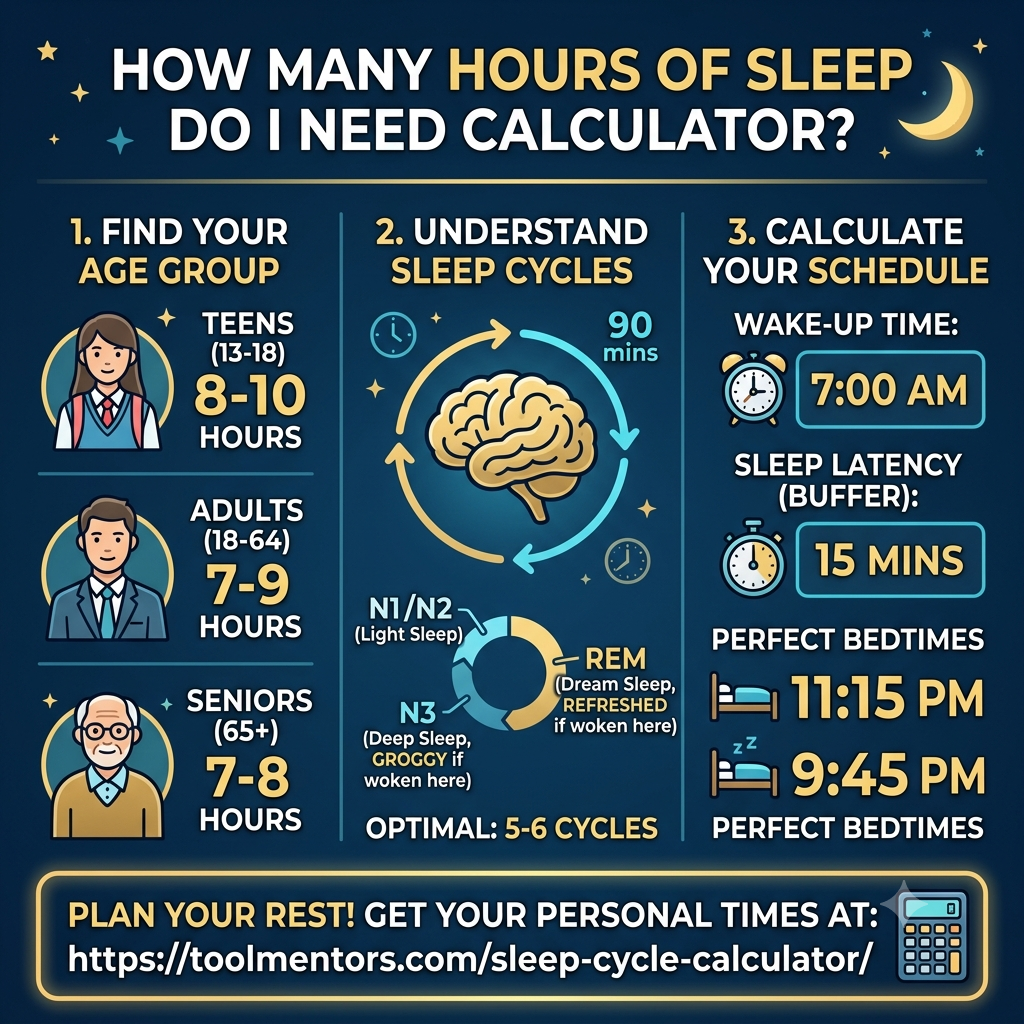
According to sleep scientists and healthcare experts, our sleep requirements change dramatically across different stages of life. Here is the standard baseline recommendation for daily rest:
| Age Group | Recommended Daily Sleep Hours |
| Teens (13–18 years) | 8 to 10 Hours |
| Adults (18–64 years) | 7 to 9 Hours |
| Seniors (65+ years) | 7 to 8 Hours |
However, just hitting these raw hourly numbers isn’t enough. The real secret to waking up fully energized lies in tracking your Sleep Cycles, not just the total time spent in bed.
The Core Math Behind a Sleep Duration Calculator
During the night, your brain moves through repeating architecture blocks known as 90-minute sleep cycles. Each cycle transitions you from light sleep to deep restorative sleep, and finally into REM (dreaming) sleep.
If your alarm rings while you are stuck in the middle of a deep sleep phase, you will suffer from “sleep inertia”—leaving you feeling completely groggy, heavy, and tired, regardless of how many hours you slept.
This is why an accurate sleep calculator counts your rest in complete 90-minute intervals:
-
4 Full Cycles: 6 Hours of sleep (Manageable for busy nights, but below optimal)
-
5 Full Cycles: 7.5 Hours of sleep (The ideal sweet spot for most adults)
-
6 Full Cycles: 9 Hours of sleep (Excellent for deep physical recovery and athletes)
Stop Guarding Your Sleep: Use the ToolMentors Calculator
You don’t need to stay up doing manual bedtime math or subtracting hours in your head.
You can easily automate your entire sleep schedule using the free ToolMentors How Many Hours of Sleep Do I Need Calculator.
Our intelligent tool takes your desired wake-up time and automatically adds a 15-minute sleep latency buffer (the average time it takes a human to actually fall asleep after turning off the lights). It then lays out precise, scientifically backed bedtime choices based on perfect 90-minute cycle completions.
By targeting exactly 5 or 6 complete cycles, you can align your alarm seamlessly with your natural biological rhythms and wake up feeling completely refreshed.