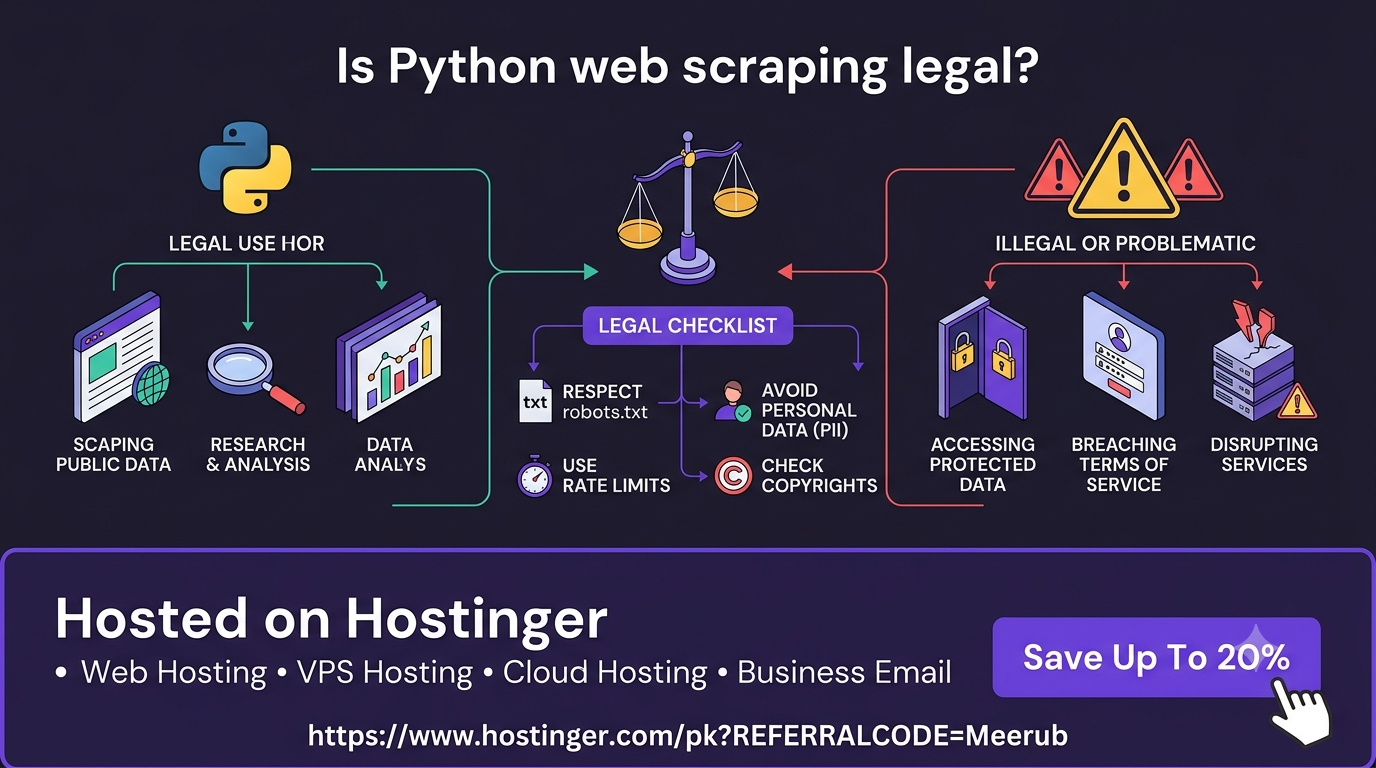
Python web scraping is legal when collecting publicly accessible, non-copyrighted data without bypassing authentication barriers or technical access controls. However, harvesting personally identifiable information (PII), breaching explicit terms of service through logged-in accounts, or overloading target servers can expose developers to significant legal liability.
Is Python Web Scraping Legal? The Plain Truth Explained
Web scraping—the automated extraction of data from websites using code—is the backbone of search engine indexing, competitive price monitoring, machine learning datasets, and market research. Because Python offers powerful libraries like BeautifulSoup, Scrapy, and Playwright, it has become the default programming language for building scrapers.
However, the question “Is Python web scraping legal?” does not have a simple “yes” or “no” answer. Legality depends on what data you scrape, how you access it, and what you do with it after extraction.
In general, scraping publicly available information is legal in most jurisdictions, including the United States and the European Union. Landmark judicial rulings—such as hiQ Labs v. LinkedIn and Meta Platforms v. Bright Data—have consistently held that retrieving public facts visible to any standard web browser does not constitute illegal hacking or unauthorized access.
Despite these favorable legal precedents, web scraping exists at the intersection of several distinct legal frameworks. Understanding these boundaries is critical to building compliant, ethical automated data pipelines.
Key Legal Frameworks Every Python Developer Must Understand
1. The Computer Fraud and Abuse Act (CFAA)
In the United States, the Computer Fraud and Abuse Act (CFAA) penalizes individuals who access a computer system “without authorization” or “exceed authorized access”.
Historically, companies attempted to use the CFAA to criminalize web scraping. However, the U.S. Supreme Court ruling in Van Buren v. United States (2021) and subsequent Ninth Circuit decisions affirmed that accessing public web pages—where no password, paywall, or technical authentication block is circumvented—is not a violation of federal anti-hacking laws.
2. Breach of Contract & Website Terms of Service (ToS)
While scraping public data might not be a crime under anti-hacking statutes, it can still lead to civil breach-of-contract lawsuits.
If a user must create an account, log in, and click “I Agree” to access data, they enter into a legally binding contract. If those Terms of Service explicitly prohibit automated data collection, scraping data from inside that logged-in session can result in account termination and legal action.
3. Copyright Laws vs. Raw Factual Data
Copyright law protects creative expression (such as original articles, literary prose, artwork, video content, and graphic designs). It does not protect raw facts, numbers, public prices, or directory lists.
-
Legal: Scraping public e-commerce prices, product specifications, or public contact directories to analyze trends or build price-comparison models.
-
Illegal: Scraping entire copyrighted blog posts or copyrighted images to republish them verbatim on a competing website without authorization.
4. Global Data Privacy Regulations (GDPR & CCPA)
When scraping personal data, privacy frameworks override general public-access rules.
Under the European Union’s General Data Protection Regulation (GDPR) and California’s CCPA/CPRA, personal data includes full names, email addresses, phone numbers, location data, and IP addresses. Scraping personally identifiable information (PII) without a lawful basis or explicit user consent can result in hefty regulatory fines, regardless of whether the profile was public.
5. Server Abuse & Trespass to Chattels
Sending tens of thousands of automated requests per minute can overwhelm a target server, causing denial-of-service (DoS) disruptions or increased infrastructure costs for the site owner. Courts treat server hammering as “trespass to chattels” or server abuse.
Step-by-Step Guide: How to Scrape Legally & Ethically with Python
To keep your Python scraping scripts compliant and running smoothly, follow this technical blueprint.
Step 1: Programmatically Parse robots.txt
The robots.txt file specifies which site directories web crawlers are permitted or forbidden to access. Python’s built-in urllib.robotparser module makes it simple to verify permissions before sending requests:
import urllib.robotparser

rp = urllib.robotparser.RobotFileParser()
rp.set_url("https://example.com/robots.txt")
rp.read()

# Check if your bot is allowed to crawl a specific URL
url_to_scrape = "https://example.com/products"
user_agent = "MyEthicalScraperBot"

if rp.can_fetch(user_agent, url_to_scrape):
    print("Allowed to scrape!")
else:
    print("Access forbidden by robots.txt")
Step 2: Implement Rate Limiting and Delays
Always throttle your requests to mimic human browsing speeds and prevent server strain. Use Python’s time.sleep() or asynchronous task scheduling:
import time
import requests

urls = ["https://example.com/page1", "https://example.com/page2"]
headers = {"User-Agent": "MyEthicalScraperBot/1.0 (+https://mycompany.com/contact)"}

for url in urls:
    response = requests.get(url, headers=headers)
    print(f"Scraped {url} with status {response.status_code}")
    # Pause for 3 seconds between requests to avoid overloading the server
    time.sleep(3)
Step 3: Identify Your Scraper via Custom User-Agent Headers
Anonymous or deceptive User-Agent strings look suspicious. Always pass a custom User-Agent header that includes your bot name and a contact email so webmasters can reach you if needed.
Step 4: Deploy Your Scrapers on a Reliable Cloud VPS
Running continuous or scheduled web scrapers from your personal home computer is risky. Residential internet providers frequently block outbound web scraping traffic or assign dynamic IP addresses that get flagged easily. Furthermore, leaving a laptop powered on 24/7 wastes power and lacks reliability.
The professional solution is deploying your Python scrapers to a high-uptime Virtual Private Server (VPS). Hosting your scrapers on a cloud server gives you:
-
A static, dedicated IP address.
-
Sufficient CPU and RAM to run headless browsers like Playwright or Selenium.
-
Uninterrupted 24/7 execution via Linux background process managers (such as
systemdorPM2). -
High-bandwidth connectivity for rapid data ingestion.
Real-World Benefits for Students, Developers, and Freelancers
| Target Audience | Practical Applications & Real-World Value |
| Students & Researchers | Collect public academic data, track social trends, build historical datasets for thesis research, and practice statistical analysis without manual copy-pasting. |
| Freelancers & Agencies | Build custom lead generation software, price comparison dashboards, automated inventory monitors, and SEO tracking tools for paying clients. |
| Developers & Engineers | Train custom machine learning models, aggregate API-less data sources, feed automated backend pipelines, and build SaaS micro-services. |
Essential Best Practices Checklist
-
Check
robots.txtFirst: Always check crawl rules before writing extraction logic. -
Scrape Only Public Data: Do not bypass paywalls, login screens, or CAPTCHAs to access restricted content.
-
Respect Data Privacy: Filter out Personally Identifiable Information (PII) like names, emails, and phone numbers.
-
Limit Request Frequency: Use rate-limiting delays to prevent high server loads.
-
Host on Enterprise Infrastructure: Deploy your scrapers on a dedicated cloud host for maximum speed and uptime.
Ready to Deploy Your Python Scrapers with 99.9% Uptime?
Building ethical, high-performance Python web scrapers requires reliable, high-speed hosting infrastructure that runs 24 hours a day, 7 days a week.
Hostinger VPS Hosting provides the ultimate cloud hosting environment for Python developers, freelancers, and data engineers. With full root access, lightning-fast NVMe storage, dedicated IPv4/IPv6 addresses, and pre-configured Linux operating systems, Hostinger makes it seamless to run continuous Python scripts, Scrapy projects, and headless Playwright instances.
Exclusive Discount for Developers & Automation Experts
Claim an EXCLUSIVE 20% DISCOUNT on all Hostinger web hosting and cloud VPS packages today!
Get root access, high-speed compute resources, and total deployment control at an unbeatable price point.
Claim Your 20% Off Hostinger Hosting Discount Now
Launch your Python scrapers on Hostinger today and experience enterprise-level speed, rock-solid security, and uninterrupted uptime.