

Planning your financial future doesn’t have to be a guessing game. Whether you are aiming to buy a home, fund higher education, or build a robust retirement nest egg, steady investing is the key. Among the most disciplined ways to grow your money is through a Systematic Investment Plan (SIP).
To help you map out your financial journey without complex manual math, using the best SIP calculator is the ultimate shortcut to precision planning.
What is a SIP and Why Should You Start One?
A Systematic Investment Plan (SIP) is a smart, automated method offered by mutual funds that allows you to invest a fixed amount of money at regular intervals—usually monthly. Instead of waiting to accumulate a massive lump sum of cash, a SIP lets you enter the market instantly with smaller, manageable installments.
By consistently investing over time, you benefit from market cycles without trying to “time” the market perfectly.
Why You Need a Mutual Fund SIP Calculator
When building an investment strategy, you need clear, predictable data. A SIP investment calculator eliminates the guesswork by instantly visualizing how your monthly contributions grow over time.
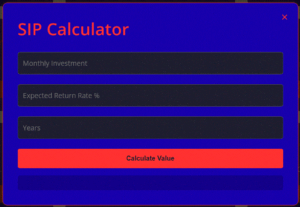
By simply adjusting three basic inputs—your monthly investment, your expected annual rate of return, and your total investment timeline—the tool clearly presents your total invested capital versus your estimated wealth gain. It allows you to run multiple scenarios until you find the exact strategy that matches your budget and lifestyle.
The Hidden Mechanics: Rupee/Dollar Cost Averaging and Compounding
The true power of using a SIP return calculator becomes obvious when you look at the long-term projections. SIPs rely on two core financial pillars:
-
Cost Averaging: When market prices fall, your fixed monthly allocation automatically purchases more mutual fund units. When prices rise, it buys fewer units. Over a long horizon, this averages out your acquisition cost and lowers overall investment risk.
-
The Power of Compounding: You do not just earn returns on your initial capital; you earn returns on your accumulated returns. Over 5, 10, or 20 years, this compound effect snowballs, turning modest monthly savings into substantial wealth.
 Frequently Asked Questions (FAQs)
Q1. What is a SIP?
Ans: SIP stands for Systematic Investment Plan. It is a method of investing in mutual funds where you invest a fixed amount of money at regular intervals (monthly, quarterly, etc.) rather than making a one-time lump-sum payment.
Q2. How does a SIP Calculator work?
Ans: A SIP Calculator is an online financial tool that operates on a fixed mathematical formula. When you input your monthly investment amount, expected annual return rate (%), and the investment duration (years), the calculator instantly displays the estimated total maturity value and wealth gained.
Q3. Are the results of a SIP Calculator 100% accurate?
Ans: A SIP Calculator provides a safe, estimated projection based on the return rate you enter. Since mutual fund investments are subject to market volatility, the actual returns may vary slightly higher or lower.
Q4. What is the minimum amount required to start a SIP?
Ans: Most mutual fund schemes allow you to start a SIP with an amount as low as $5 / ₹500 per month (depending on your region), making it accessible for almost everyone.
Q5. What is the difference between a Lump-sum and a SIP investment?
Ans: In a Lump-sum investment, you deposit a large chunk of money all at once. In a SIP, you invest smaller amounts periodically, which mitigates market timing risks and averages out the purchase cost over time.
Q6. What is the formula used to calculate SIP returns?
Ans: A SIP calculator uses the Future Value (FV) formula of annuity:
Where $P$ is the monthly investment amount, $i$ is the periodic interest rate ($\frac{\text{Annual Rate}}{12 \times 100}$), and $n$ is the total number of monthly installments.
Q7. What is Rupee/Dollar Cost Averaging, and how does it benefit SIP investors?
Ans: When the market falls, your fixed monthly amount buys more mutual fund units; when the market rises, it buys fewer units. Over time, this averages out the cost per unit, protecting you from market fluctuations. This process is called Cost Averaging.
Q8. How does compounding affect a SIP?
Ans: Compounding means you earn returns not just on your principal investment, but also on the returns already generated. The longer your investment horizon, the more aggressively compounding multiplies your wealth.
Q9. Can I increase the amount of an ongoing SIP?
Ans: Yes, many fund houses offer a Step-up SIP feature. This allows you to automatically increase your monthly investment amount by a fixed percentage or amount every year inline with your income growth.
Q10. Can I pause my SIP investment at any time?
Ans: Yes, if you face a temporary financial crunch, most mutual funds allow you to pause your SIP for a few months without cancelling the plan or charging a penalty.
Q11. Is investing via SIP risk-free?
Ans: No, SIP investments are tied to mutual funds that invest in equity or debt markets, meaning they carry market risk. However, over a long-term period (5–10 years), the risk is significantly minimized due to market averaging.
Q12. What is a realistic return rate to expect from a long-term SIP?
Ans: For long-term equity mutual funds (5+ years), a realistic average historical return falls between 12% to 15% annually, outperforming traditional savings or fixed deposits.
Q13. Are SIP investments taxable?
Ans: Tax rules depend on the type of mutual fund (Equity vs. Debt) and your region’s tax laws. Generally, investments held for over a year attract Long-Term Capital Gains (LTCG) tax, which is typically lower than short-term taxes.
Q14. What is the ideal tenure for a SIP investment?
Ans: To witness the true power of compounding and wealth creation, a minimum investment horizon of 5 to 10 years or longer is highly recommended.
Q15. Is there a penalty or fee for withdrawing money from a SIP?
Ans: Some mutual funds charge an Exit Load (usually around 1%) if you withdraw your investment within the first year. Post one year, withdrawals are usually free of exit charges. Always check the fund’s scheme document.
Q16. Can I run multiple SIPs simultaneously?
Ans: Absolutely. You can start multiple SIPs across different categories (e.g., Large-cap, Mid-cap, or Index funds) to diversify your portfolio and target different financial goals.
Q17. Does the SIP Calculator account for inflation?
Ans: Standard SIP calculators show absolute returns and do not auto-adjust for inflation. To calculate inflation-adjusted real value, you can subtract the expected inflation rate (e.g., 5-6%) from your estimated return rate before calculating.
Q18. How do I choose the right ‘Expected Rate of Return’ in the calculator?
Ans: You should base this on historical asset class performance. For Equity funds, a conservative 12% is ideal for projections, while Debt funds should be calculated around 7-8%.
Q19. What happens if my bank account lacks funds on the SIP auto-debit date?
Ans: The mutual fund company will not fine you, but your bank may charge a standard ‘auto-debit/NACH failure’ fee. If your SIP fails consecutively for 3 months, the fund house may deactivate the automated plan.
Q20. How do I choose the right mutual fund to start my SIP?
Ans: Evaluate the fund’s 5-year track record, the fund manager’s experience, the expense ratio (fees), and risk parameters (Alpha/Beta). Use our calculator to map out how different funds’ historical returns line up with your financial targets.
Start Planning Your Goals Today
Whether your goal is big or small, consistency beats intensity every time. Head over to our main directory at ToolMentors Multi-Tools to use our free, high-precision SIP Calculator tool. Test out different monthly amounts and durations to easily build your customized blueprint for financial freedom!