
Have you ever slept for a full 8 or 9 hours, only to wake up feeling completely exhausted, groggy, and ready to crawl back into bed? On the flip side, have you ever pulled a near-all-nighter, slept for just 4.5 hours, and woken up feeling surprisingly sharp?
The secret behind this isn’t just the total hours you spend in bed—it’s all about your sleep cycles.
If you want to stop waking up tired, understanding how many sleep cycles you need is the ultimate game-changer. Let’s break down the science of sleep cycles and discover the magic number for your body.
What is a Sleep Cycle? (The Science of Snoozing)
Your brain doesn’t just shut off when you fall asleep. Instead, it goes through a highly structured roller coaster ride divided into distinct phases.
A single sleep cycle lasts roughly 90 minutes on average and consists of two main categories: NREM (Non-Rapid Eye Movement) and REM (Rapid Eye Movement) sleep.
As shown in the breakdown above, each 90-minute cycle takes you through light sleep, drops you into deep restorative slow-wave sleep (where your body repairs itself), and ends in REM sleep (where vivid dreaming happens and your brain processes memories).
The trick to waking up refreshed is simple: You need to wake up at the end of a cycle (during light sleep), not in the middle of deep sleep. Waking up during deep sleep triggers “sleep inertia,” which causes that heavy, morning grogginess.
What is the Best Amount of Sleep Cycles to Have?
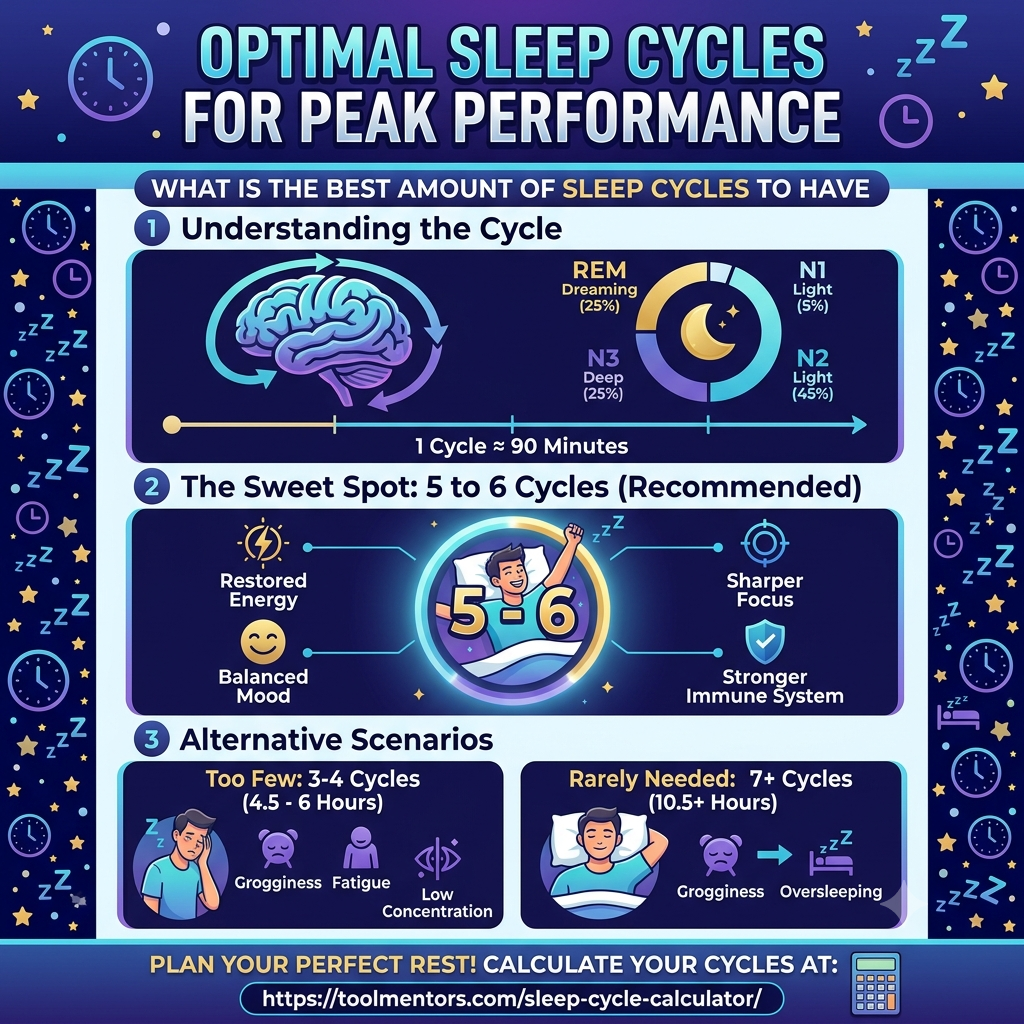
For most healthy adults, the golden rule is to get 5 to 6 sleep cycles per night.
Since one cycle is about 90 minutes, let’s do the math:
-
5 Cycles: 5 x 90 minutes = 450 minutes (7.5 hours of sleep)
-
6 Cycles: 6 x 90 minutes = 540 minutes (9 hours of sleep)
While 5 to 6 cycles is the absolute best sweet spot for long-term health, mental clarity, and cellular repair, your individual daily needs might fluctuate:
-
The Optimal Goal (5-6 Cycles): This aligns perfectly with the National Sleep Foundation’s recommendation of 7 to 9 hours of sleep for adults. It ensures your brain gets enough deep sleep and REM stages to function at 100%.
-
The “Busy Day” Minimum (4 Cycles): 4 cycles equal exactly 6 hours of sleep. While it is doable for a night or two, consistently getting only 4 cycles can lead to a chronic sleep debt, affecting your immune system and focus.
-
The Emergency Mode (3 Cycles): 3 cycles equal 4.5 hours. If you are tight on time, aiming for exactly 4.5 hours is often much better than sleeping for 5.5 hours, because you are timing your alarm to go off right as a cycle finishes.
How to Calculate Your Perfect Bedtime
Calculating this manually every single night can be tricky—especially since the average person takes about 14 to 20 minutes to actually fall asleep once their head hits the pillow.
If you want to skip the math and get precise times for when you should sleep or set your alarm, you can use the free ToolMentors Sleep Cycle Calculator.
Whether you know exactly what time you need to wake up, or you are staring at the clock wondering when to sleep, this tool factors in the 90-minute cycles and standard sleep latency (the time it takes to fall asleep) to give you the perfect biological windows.
3 Quick Tips to Optimize Your Sleep Quality
Getting the right number of cycles is vital, but the quality of those cycles matters just as much. If your environment keeps waking you up, your cycles get interrupted. Here is how to protect them:
-
Keep it Dark and Cool: Your body temperature needs to drop slightly to initiate deep slow-wave sleep. Keep your bedroom temperature comfortable and block out ambient light.
-
Ditch the Blue Light: Avoid smartphones or laptops at least 30-60 minutes before bed. Blue light tricks your brain into thinking it’s daytime, delaying the release of melatonin (the sleep hormone).
-
Be Consistent: Going to bed and waking up at the same time every day trains your internal circadian rhythm. Eventually, your body will naturally finish its 5th or 6th cycle right before your alarm goes off.
The Bottom Line
Don’t just count hours; count your cycles. Aiming for 5 or 6 complete sleep cycles (7.5 or 9 hours) will dramatically improve your energy levels, mood, and daily productivity.
Ready to plan your perfect night of rest? Head over to the ToolMentors Sleep Cycle Calculator to discover your ideal bedtime tonight!