
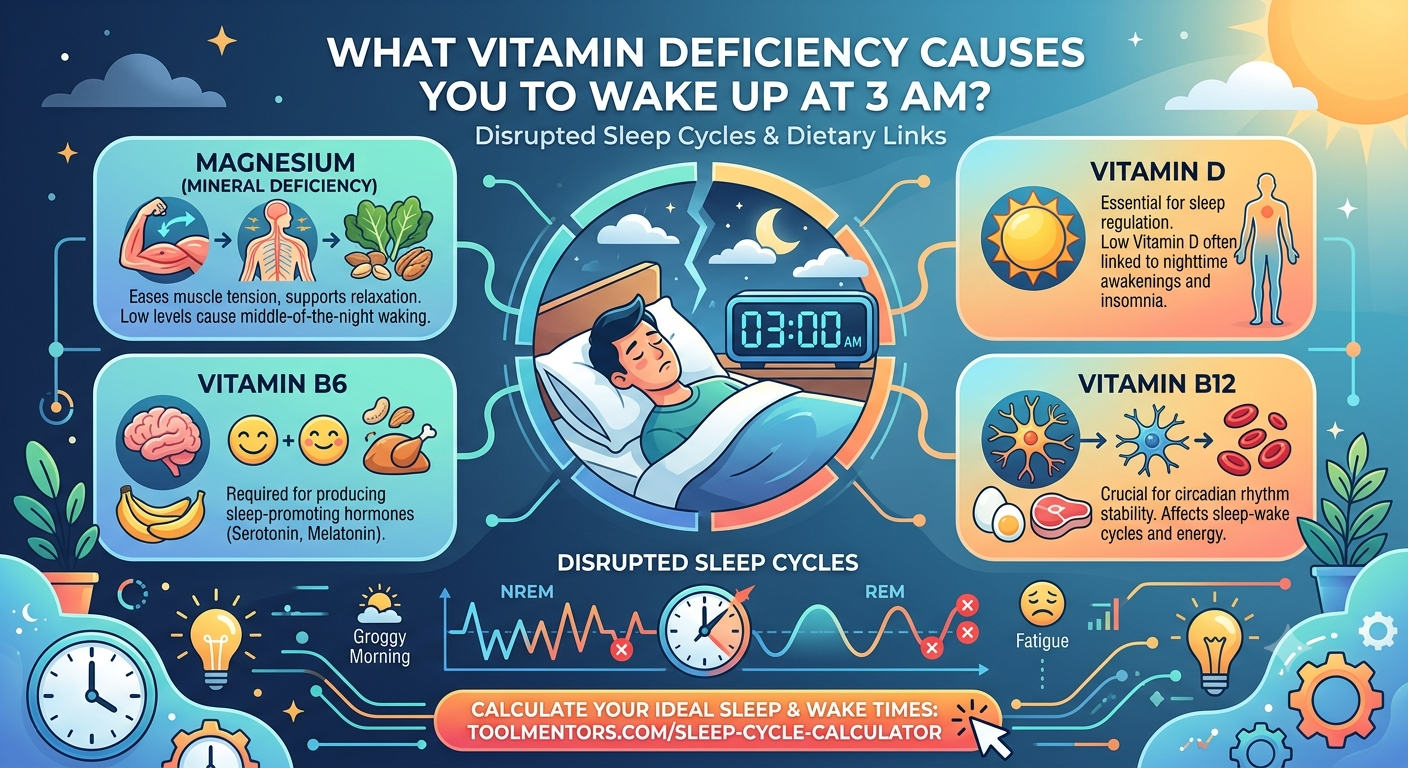
It is a frustratingly common scenario: your eyes snap open, you check your phone, and it is exactly 3:00 AM. Waking up in the middle of the night—often referred to as nocturnal awakenings—can disrupt your sleep cycles and leave you feeling completely drained the next day.
While stress, anxiety, and a late-night heavy meal are frequent culprits, science shows that your diet plays a massive role in your sleep patterns. Specifically, certain micronutrient deficiencies can directly sabotage your ability to stay asleep.
If you find yourself consistently waking up around 3:00 AM, here are the primary vitamin and mineral deficiencies that might be responsible.
1. Vitamin D (The “Sunshine” Vitamin)
Vitamin D is not just essential for bone health; it acts as a hormone that directly affects sleep regulation.
-
The Connection: Your brain has vitamin D receptors in the areas that control your sleep-wake cycles. A deficiency in Vitamin D is strongly linked to short sleep duration, poor sleep quality, and frequent nighttime awakenings.
-
Why 3 AM? When Vitamin D levels are low, your body struggles to maintain stable deep sleep stages, making you highly susceptible to waking up during the lighter shifts in your natural sleep cycle.
2. Vitamin B6 and B12
The B-complex family is crucial for cellular energy and neurological health.
-
Vitamin B6: This vitamin is a key co-factor in producing melatonin (the sleep hormone) and serotonin (the mood-regulating neurotransmitter). Without enough B6, your body cannot efficiently signal to your brain that it is time to remain asleep.
-
Vitamin B12: B12 helps regulate your circadian rhythm. A deficiency can cause your internal body clock to become erratic, leading to sudden disruptions in the middle of the night.
3. Magnesium (The Ultimate Sleep Mineral)
While technically a mineral rather than a vitamin, magnesium deficiency is one of the leading dietary causes of 3 AM wake-ups.
-
The Connection: Magnesium binds to gamma-aminobutyric acid (GABA) receptors. GABA is the neurotransmitter responsible for calming down nerve activity and relaxing the nervous system.
-
The Result: Low magnesium levels keep your nervous system in a “hyperexcitable” state. As your body transitions between sleep cycles around 3 AM, a stressed nervous system will easily cause you to wake up completely alert.
The Sleep Cycle Connection: Why 3 AM Matters
Every night, your brain moves through repeating 90-minute sleep cycles consisting of light sleep, deep sleep, and REM sleep.
By the time you have been asleep for 4 to 5 hours (which usually aligns with 3:00 AM for most bedtimes), your body has finished most of its deep, restorative physical sleep and spends more time in lighter REM sleep. If your body lacks the vital nutrients required to transition smoothly between these cycles, you will break character from your sleep and wake up.
Fix Your Schedule While Fixing Your Diet
Correcting a vitamin deficiency takes time, but you can immediately improve your sleep quality by optimizing your sleep timing based on your internal clock.
🛠️ Plan Your Cycles: Use our free Sleep Cycle Calculator to find the exact perfect time to go to bed or set your alarm so you can transition smoothly through your sleep stages without waking up mid-cycle.
How to Stop the 3 AM Wake-Ups
-
Get Tested: Ask your doctor for a routine blood panel to check your Vitamin D, Vitamin B12, and Magnesium levels.
-
Adjust Your Diet: Incorporate sleep-supportive foods into your evening meals. Fatty fish (rich in Vitamin D and B6), leafy greens, nuts, and seeds (loaded with magnesium) are excellent choices.
-
Smart Supplementation: If dietary changes aren’t enough, high-quality supplements like Magnesium Glycinate or a targeted Vitamin D3/K2 drop can help bridge the gap. Always consult a healthcare professional before starting new supplements.
Fixing your nutritional foundation, paired with precise sleep tracking, is the ultimate formula to reclaim your nights and wake up fully refreshed!