
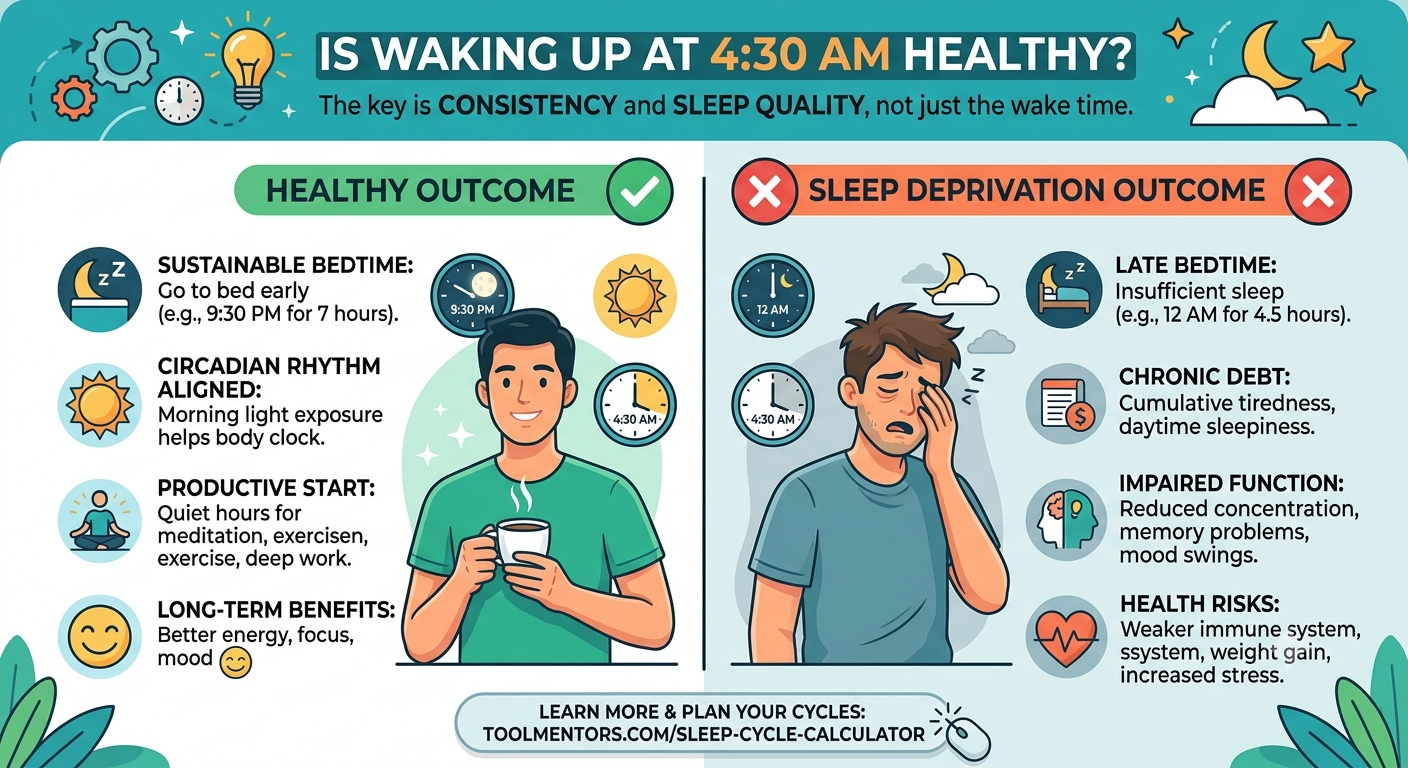
The “CEO sleep schedule” has taken the world by storm. From high-flying executives to fitness influencers, waking up before the sun—specifically around 4:30 AM—is often praised as the ultimate productivity hack.
But from a biological and medical standpoint, is waking up at 4:30 AM actually healthy?
The short answer is: Yes, but only if you go to bed early enough to complete your natural sleep cycles. Waking up early without adjusting your bedtime is a recipe for chronic sleep deprivation, which destroys productivity rather than building it.
The Biological Truth: Chronotypes and Your Circadian Rhythm
Your body is governed by an internal clock known as the circadian rhythm. This clock controls when you feel alert and when you feel sleepy by releasing hormones like melatonin and cortisol.
Not everyone is wired the same way. Genetically, humans fall into different chronotypes:
-
Larks (Early Birds): Naturally energetic early in the day. Waking up at 4:30 AM feels great for this group.
-
Owls (Night Owls): Naturally hit their peak focus late in the evening. Forcing a 4:30 AM wake up time on a night owl can cause long-term health issues like brain fog, low immunity, and high stress levels.
If your genetics allow you to be an early bird, a 4:30 AM routine can be incredibly healthy—provided you get 7.5 to 9 hours of sleep.
The Math: When Should You Go to Bed for a 4:30 AM Wake Up?
To wake up naturally alert at 4:30 AM, you need to time your sleep around standard 90-minute sleep cycles. Healthy adults need about 5 to 6 full cycles per night.
If you want to open your eyes at 4:30 AM, here are your optimal bedtimes (factoring in roughly 15 minutes to actually fall asleep):
-
For 5 Complete Cycles (7.5 Hours of Sleep): You must be asleep by 9:00 PM. Target Bedtime: 8:45 PM
-
For 6 Complete Cycles (9 Hours of Sleep): You must be asleep by 7:30 PM. Target Bedtime: 7:15 PM
If you are going to bed at 11:30 PM or midnight and waking up at 4:30 AM, you are only getting 4 to 5 hours of sleep. Over time, this creates a severe “sleep debt” that impacts your heart health, weight management, and mental sharpness.
Eliminate the Guesswork
Instead of struggling with sleep schedules and calculating time intervals in your head, let technology do the work for you.
🛠️ Optimize Your Sleep: Use our free Sleep Cycle Calculator to instantly find the exact minute you need to go to sleep to make a 4:30 AM wake up time perfectly healthy and effortless.
Pros and Cons of a 4:30 AM Wake Up Schedule
The Benefits (The Pros):
-
Zero Distractions: At 4:30 AM, your phone isn’t buzzing, emails aren’t piling up, and the house is quiet. It is prime time for deep work, exercise, or meditation.
-
Proactive Start: You start your day ahead of the world, which reduces morning anxiety and rush.
-
Better Consistency: Early risers often find it easier to keep a steady daily routine.
The Risks (The Cons):
-
Social Isolation: Going to bed by 8:45 PM means sacrificing late-night family dinners, social events, or winding down with friends.
-
Afternoon Slumps: If your sleep cycles aren’t fully optimized, you may experience a massive energy crash around 1:00 PM or 2:00 PM.
Final Verdict: Should You Do It?
Waking up at 4:30 AM is healthy only if it is sustainable for your lifestyle and biological clock. If you can consistently hit the sack before 9:00 PM, your body will thrive. If your career or family life requires you to stay up late, forcing yourself up at 4:30 AM will do more harm than good.
Focus on the quality and cycles of your sleep, not just the early hour on your alarm clock!