
Have you ever slept for a full 8 or 9 hours, only to wake up feeling completely exhausted, groggy, and ready to crawl straight back into bed?
Conversely, have you ever woken up after just 6 hours of sleep feeling surprisingly refreshed and sharp?
The truth is, waking up energized has less to do with the total number of hours you sleep and more to do with how many complete sleep cycles you finish. If you align your bedtime and wake up time with your body’s natural internal biological clock, you can eliminate morning grogginess entirely.
The Science: Why “Total Hours” Isn’t Everything
When you fall asleep, your brain doesn’t just switch off. Instead, it travels through a series of repeating stages that make up a single Sleep Cycle.
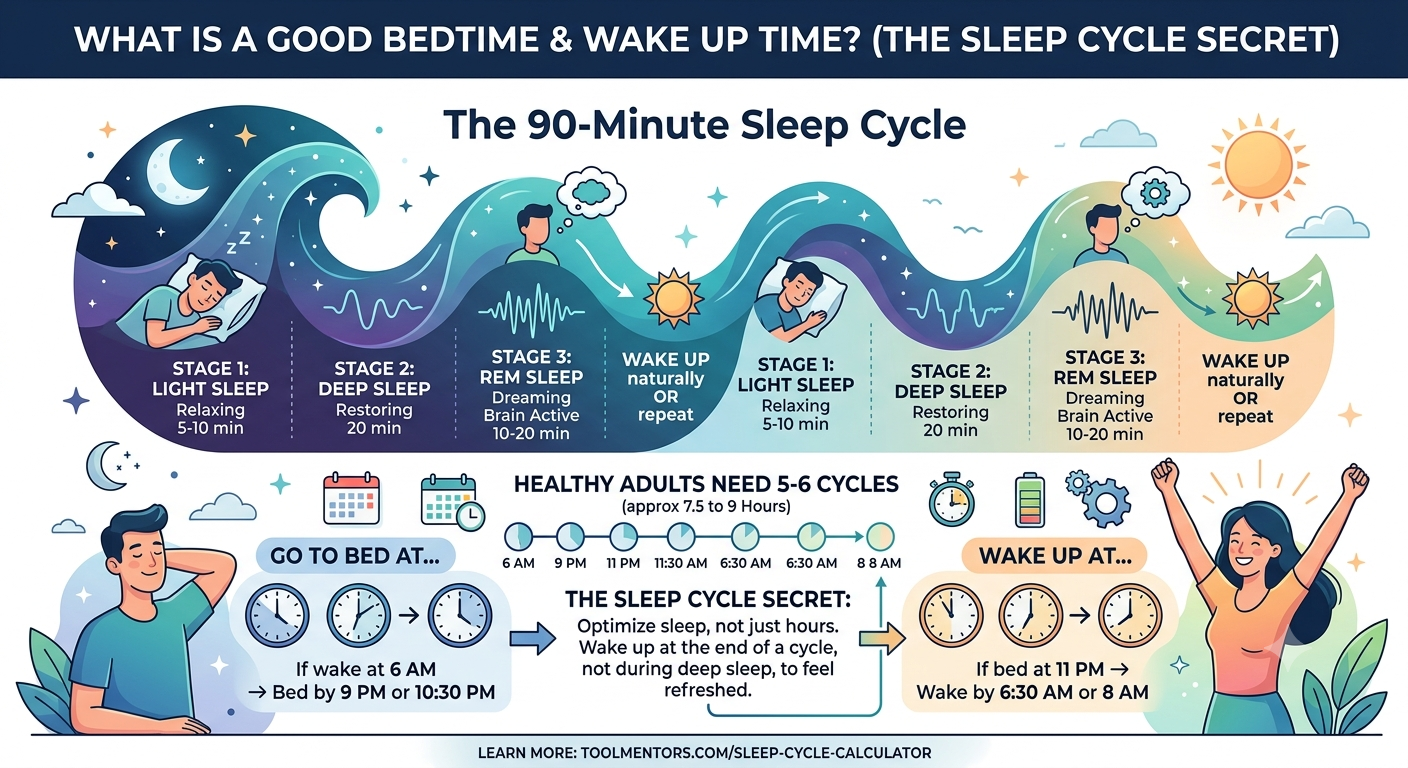
As shown in the diagram above, a healthy sleep cycle moves through four distinct stages:
-
N1 & N2 (Light Sleep): The transition stages where your breathing slows down, muscles relax, and your body prepares for deeper rest.
-
N3 (Deep Sleep): The physical recovery stage. This is when your body repairs tissue, builds bone and muscle, and strengthens the immune system.
-
REM (Vivid Dreaming): The mental recovery stage. This is where your brain processes memories, emotions, and information from the day.
For the average adult, a single complete cycle takes roughly 90 minutes to complete.
Why You Wake Up Groggy
If your alarm goes off while you are in the middle of N3 (Deep Sleep), your brain suffers from a physiological state called sleep inertia. You will feel heavy, disoriented, and exhausted for hours.
However, if your alarm rings right as you are completing a REM stage or moving back into Light Sleep, you will wake up naturally alert—even if you got less total sleep.
How to Calculate Your Ideal Bedtime and Wake Up Time
To wake up feeling your absolute best, you want to time your sleep in multiples of 90 minutes. Healthy adults typically need 5 or 6 full cycles per night.
-
5 Cycles x 90 Minutes = 7.5 Hours of Sleep
-
6 Cycles x 90 Minutes = 9 Hours of Sleep
Note: The average person takes about 14 to 15 minutes to actually fall asleep once their head hits the pillow. You must factor this “sleep latency” into your math!
Target Sleep Schedules Based on 90-Minute Cycles:
| If You Need to Wake Up At: | Go to Bed At (For 5 Cycles): | Go to Bed At (For 6 Cycles): |
| 5:00 AM | 9:15 PM | 7:45 PM |
| 6:00 AM | 10:15 PM | 8:45 PM |
| 7:00 AM | 11:15 PM | 9:45 PM |
| 8:00 AM | 12:15 AM | 10:45 PM |
| 9:00 AM | 1:15 AM | 11:45 PM |
Stop Doing Mental Math: Use a Precision Tool
Instead of trying to calculate 90-minute intervals and adding falling-asleep times manually in your head every night, you can automate the process perfectly.
🛠️ Try the Tool: Use our free Sleep Cycle Calculator to instantly find the exact minute you should go to sleep or set your alarm based on your unique daily routine.
Three Tips for a Better Night’s Rest
-
Keep a Consistent Schedule: Going to bed and waking up at the exact same time every day—even on weekends—anchors your circadian rhythm (your body’s internal clock), making it much easier to fall asleep naturally.
-
Limit Blue Light Exposure: Blue light emitted from smartphones, laptops, and TVs mimics daylight, blocking the production of melatonin (the hormone that tells your body it is time to sleep). Try to turn off screens at least 30 to 60 minutes before bed.
-
Optimize Your Environment: Keep your bedroom cool (around 65°F or 18°C), dark, and quiet to encourage your brain to drop smoothly into deep restorative cycles without interruptions.
Understanding your body’s natural rhythms is the fastest way to upgrade your energy levels, focus, and long-term health. Head over to our calculator, find your ideal target numbers, and start waking up refreshed tomorrow morning!