
Have you ever woken up, stared at the ceiling, and immediately started doing backward math in your head?
“Okay, I turned off the lights at 11:30 PM, but I probably fell asleep around midnight… then I woke up once at 3:15 AM… and now my alarm is ringing at 7:00 AM. So, how much sleep did I actually get?”
If this sounds familiar, you are not alone. Millions of people struggle with morning mental math, trying to figure out if they clocked enough rest to survive the workday. The truth is, guessing your sleep numbers manually is almost always inaccurate.
To track your real rest, understand your body’s recovery stages, and stop asking yourself “how much sleep did I get?”, you need to look at the science of sleep architecture.
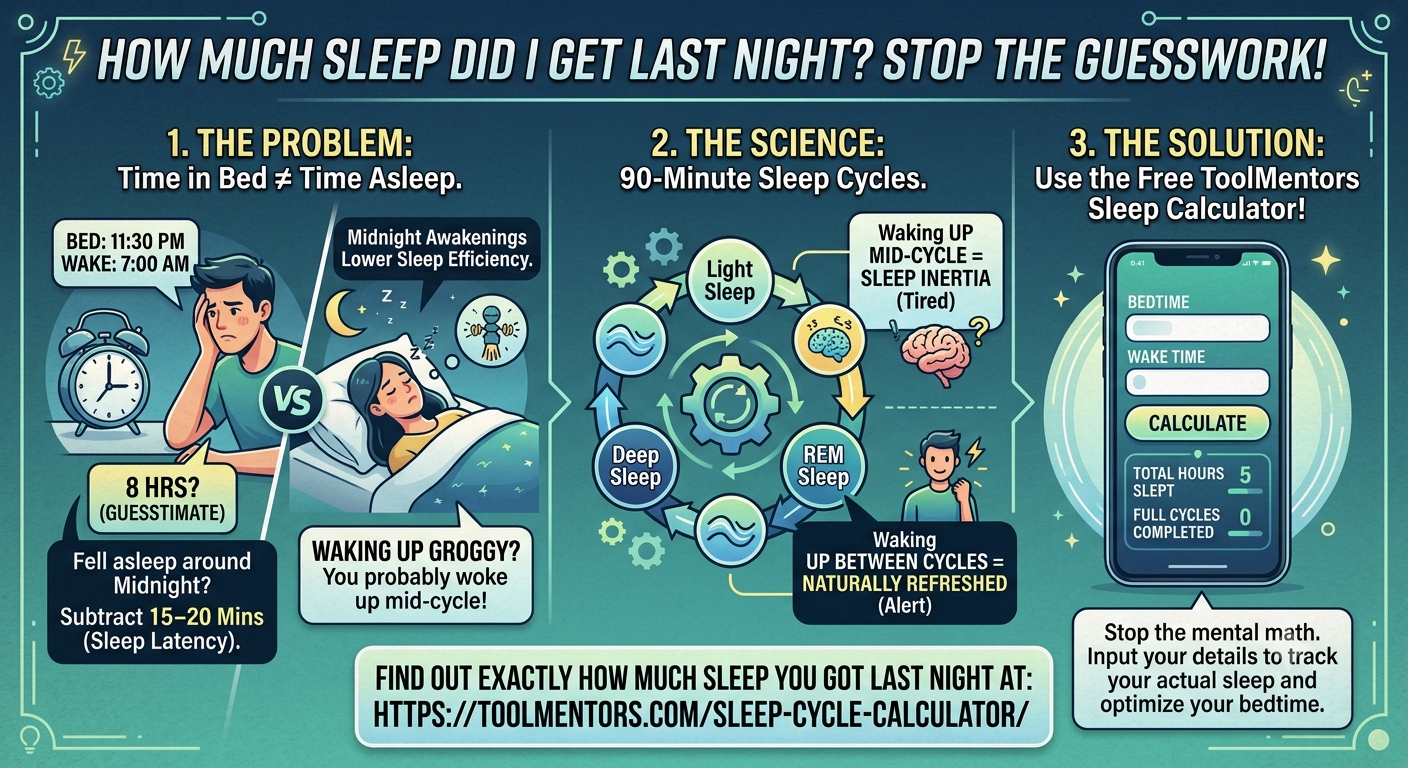
The biggest mistake people make when tracking their sleep is assuming that lying down at 11:00 PM and waking up at 7:00 AM equals a perfect 8 hours of sleep. In the digital marketing and tech world, we call this a “vanity metric.”
In reality, your total sleep duration is affected by two critical factors:
1. Sleep Latency
This is the amount of time it takes you to transition from full wakefulness to light sleep. For a healthy adult, this takes anywhere from 15 to 20 minutes. If you are scrolling through your phone or stressing about tomorrow’s to-do list, your sleep latency can stretch to an hour or more.
2. Midnight Awakenings
Your body naturally wakes up multiple times throughout the night, often for just a few seconds. While you might not remember these micro-awakenings, they chip away at your total sleep time, lowering your overall sleep efficiency.
Why You Need a Sleep Calculator (The Power of 90-Minute Cycles)
Your brain doesn’t just sleep in one solid block. Instead, it travels through distinct 90-minute sleep cycles that consist of four stages: Light Sleep, Deep Sleep, REM (Rapid Eye Movement) sleep, and a brief return to light sleep before starting over.
[Light Sleep] ➔ [Deep Sleep] ➔ [REM Sleep] ➔ [Cycle Ends/Repeats]
-
Waking up MID-CYCLE: If your alarm rings while you are deep in the middle of a sleep cycle, your brain experiences sleep inertia. You will wake up feeling groggy, confused, and exhausted—even if you slept for 9 hours.
-
Waking up BETWEEN CYCLES: If you wake up right at the end of a 90-minute cycle, you will feel naturally refreshed, alert, and energized—even if you only slept for 6 hours!
Instead of focusing purely on hours, a scientific sleep tracker focuses on optimizing your cycles.
How to Manually Calculate Your Sleep (The 3-Step Formula)
If you don’t have a tool handy, you can roughly calculate your actual sleep duration using this basic formula:
-
Note your exact bedtime: Not when you hopped into bed, but when you actually closed your eyes to sleep.
-
Subtract 15–20 minutes: Factor in your natural sleep latency.
-
Divide by 90: Take your total remaining minutes and divide them by 90 to see how many full cycles you completed.
Example: If you slept for a total of 430 minutes, $430 / 90 = 4.7$ cycles. Because you woke up right in the middle of your 5th cycle, you are highly likely to feel exhausted during your morning commute.
Stop the Mental Math: Use the Free ToolMentors Sleep Tracker
Why waste energy doing complex math when your brain is already tired? Technology can do the heavy lifting for you instantly.
We have designed a dedicated, easy-to-use tool to answer your morning question once and for all. By using the Sleep Calculator: How Much Sleep Did I Get Tool on ToolMentors, you can cut out the guesswork entirely.
How It Works:
-
Input Your Bedtime & Wake Time: Tell the tool exactly when you turned the lights off and when you woke up.
-
Get Instant Cycle Metrics: The calculator automatically subtracts standard sleep latency and breaks your rest down into total completed sleep cycles.
-
Discover Your Ideal Bedtime: It tells you exactly what time you should have gone to bed to maximize your deep sleep and REM phases.
Don’t let poor sleep timing ruin your daily productivity, focus, and long-term health. Bookmark our tracker, check your numbers every morning, and start hacking your sleep schedule for a highly energized life.
👉 Find out exactly how much sleep you got last night: ToolMentors Sleep Cycle Calculator