
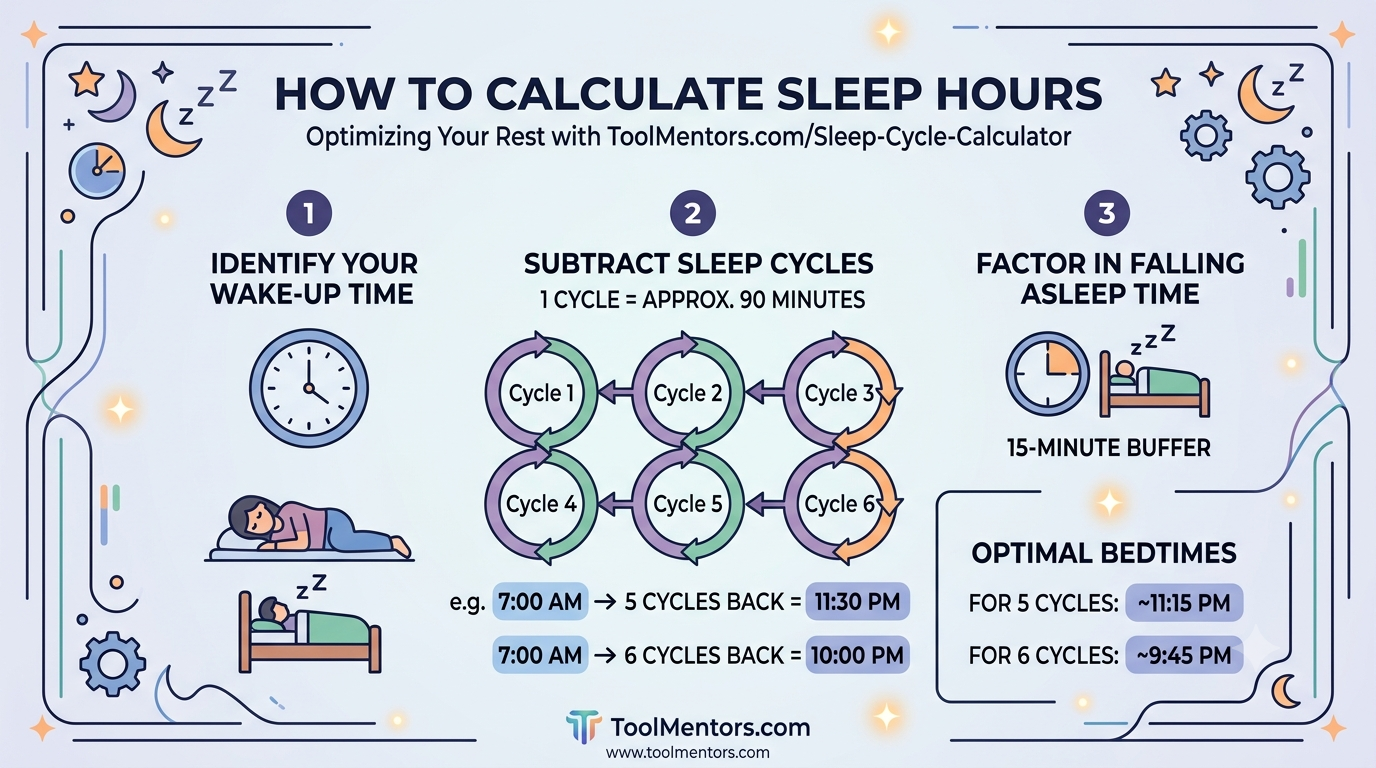
To get the most out of your page’s Sleep Cycle Calculator, it helps to understand the exact science and math happening behind the scenes.
Calculating your ideal sleep hours isn’t just about counting total hours—it is about timing your alarm to go off at the end of a natural sleep cycle so you can avoid sleep inertia (that heavy, groggy morning feeling).
Here is a detailed breakdown of how to calculate your perfect sleep schedule using the core logic of your tool.
The Core Math: The 90-Minute Rule
Human sleep naturally moves through cycles consisting of light sleep, deep sleep, and REM (Rapid Eye Movement) sleep.
1 Complete Sleep Cycle = Roughly 90 minutes.
For optimal recovery, healthy adults generally need 5 to 6 complete cycles per night.
The Calculation Formula
To find the perfect bedtime or wake-up time, your calculation needs to take into account sleep latency—the average time it takes a person to actually fall asleep after closing their eyes (standardized at 15 minutes).
Here are the two ways to calculate it manually, exactly like your tool does:
Method A: Working Backward (If you have a set wake-up time)
If you need to wake up at a specific time (e.g., 6:00 AM), calculate your bedtime options by subtracting 90-minute blocks, then subtracting an extra 15 minutes for falling asleep.
Method B: Working Forward (If you are going to bed right now)
If you are climbing into bed at 11:00 PM and want to know when to set your alarm, you add the 15-minute buffer first, and then add 90-minute intervals.
-
Bedtime: 11:00 PM
-
Estimated Sleep Onset: 11:15 PM (after 15 minutes)
-
Waking up after 5 cycles (7.5 hours of sleep): 6:45 AM
-
Waking up after 6 cycles (9 hours of sleep): 8:15 AM
Quick Reference Chart
This is how the math balances out for a standard routine based on your calculator’s primary recommendations:
| Number of Cycles | Actual Sleep Duration | Best for… |
| 4 Cycles | 6 Hours | Shift workers / Short rest nights |
| 5 Cycles | 7 Hours, 30 Minutes | Standard healthy adult target |
| 6 Cycles | 9 Hours | Heavy recovery / Athletes / Teenagers |
Why This Matters for Your Page Visitors
When users ask, “Why am I still tired after 8 hours of sleep?”, this calculation gives them the answer. Waking up after exactly 8 hours means cutting off the 5th sleep cycle right in the middle of deep sleep or REM sleep. By shifting their schedule by just 15 to 30 minutes to match the 90-minute rhythm, they wake up at the light end of a cycle, feeling instantly alert.