
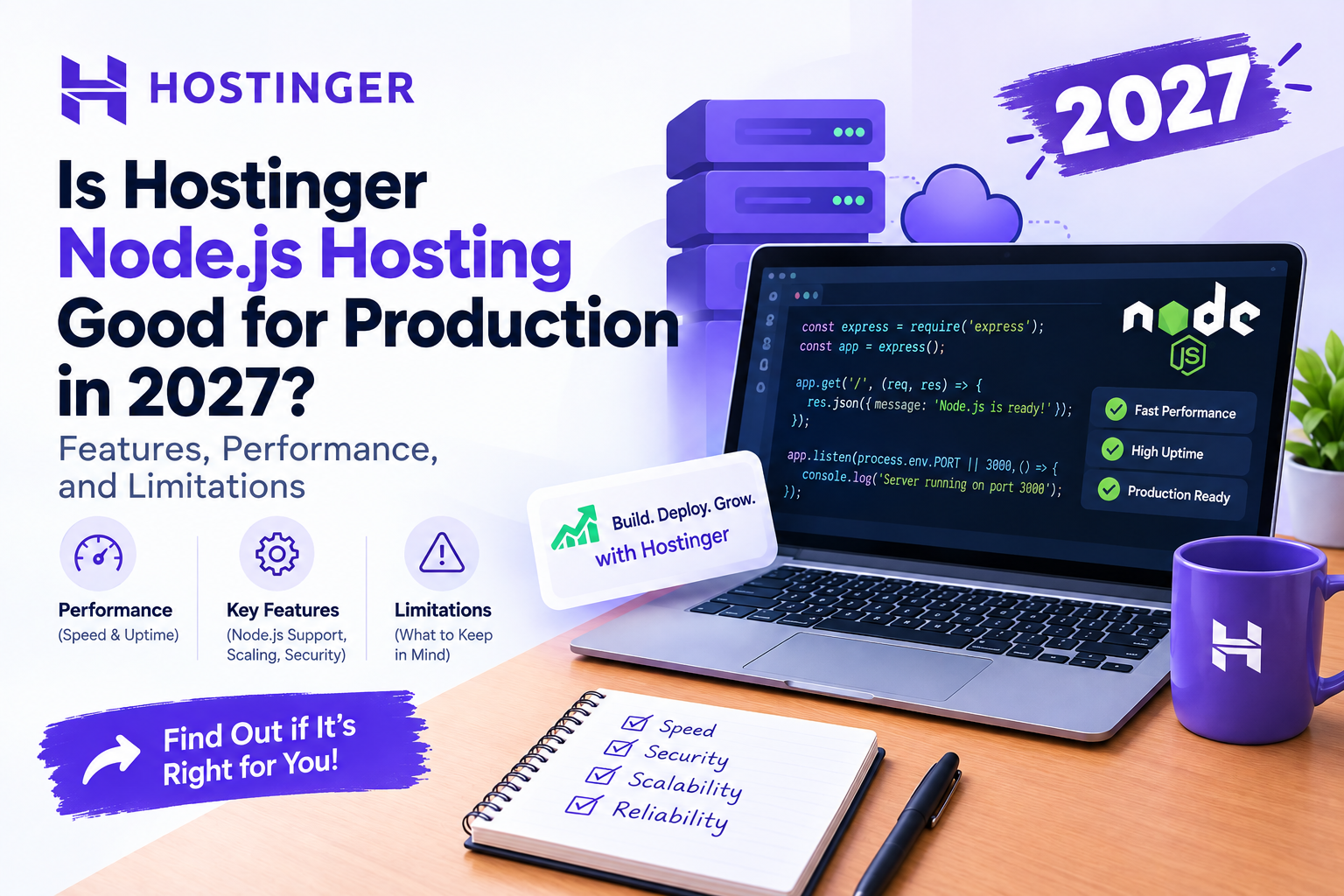
Hostinger Node.js hosting can be suitable for production applications in 2027, depending on your application’s traffic, resource requirements, and deployment needs. Before choosing a plan, evaluate its performance, scalability, security, Node.js compatibility, and limitations to determine whether it meets your production requirements.
Is Hostinger Node.js Hosting Good for Production in 2027?
Choosing the right hosting platform is an important decision when launching a Node.js application. Whether you are developing a business website, REST API, SaaS platform, or customer dashboard, your hosting environment affects application performance, reliability, security, and scalability.
Hostinger offers Node.js hosting options designed for developers who want to deploy applications online. However, is Hostinger suitable for production use in 2027?
The answer depends on your application. Hostinger may be a practical option for small and medium-sized applications, business websites, APIs, and freelance projects. Applications with demanding workloads, complex infrastructure, or strict availability requirements need more careful evaluation.
What Is Hostinger Node.js Hosting?
Node.js hosting allows you to run JavaScript on a server and build applications that process requests, connect to databases, and deliver dynamic content.
Unlike traditional static websites, Node.js applications may need a running server process to handle API requests, authentication, database operations, and other backend tasks.
Hostinger provides Node.js hosting options, including managed web application hosting and VPS hosting. These options differ in the amount of server management and control available.
Managed Node.js Hosting
Managed hosting is designed to simplify application deployment and infrastructure management.
It may be suitable for developers who want to focus on building and maintaining their applications rather than handling every server configuration task.
Common benefits include:
-
A simplified deployment workflow.
-
Application management tools.
-
Hosting infrastructure managed by the provider.
-
Support for deploying Node.js applications within the plan’s supported environment.
Node.js VPS Hosting
A Virtual Private Server (VPS) provides a virtual server with allocated resources and greater administrative control.
A VPS can be useful when you need to configure your Node.js runtime, install additional software, manage background processes, or customize your server environment.
However, additional control also means additional responsibility for configuration, security, monitoring, and maintenance.
Hostinger Node.js Hosting Features for Production
Before deploying a production application, evaluate the features available in your selected hosting plan.
1. Node.js Runtime Compatibility
Your application may depend on a particular Node.js version, framework, or package.
Before deployment, verify that your hosting plan supports:
-
The Node.js version required by your application.
-
Your framework, such as Express.js, NestJS, or Next.js.
-
Required npm packages and native dependencies.
-
Your application’s build and startup commands.
Using a compatible runtime reduces deployment problems and helps keep your application maintainable.
2. Server Resources and Application Performance
Production performance depends on more than the hosting provider’s name.
Your application’s performance can be affected by:
-
CPU availability.
-
RAM consumption.
-
Database query efficiency.
-
Application architecture.
-
Caching and content delivery.
-
Traffic spikes and concurrent requests.
A small business API may operate comfortably with modest resources, while a real-time application or data-intensive service may require more CPU and memory.
Choose a plan based on realistic workload testing instead of assuming that every Node.js application needs the same configuration.
3. Deployment and Development Workflow
A reliable deployment process helps developers release updates without unnecessary downtime or configuration errors.
Depending on the selected hosting option, available deployment methods may include Git-based deployment, application management tools, or manual deployment workflows.
Before choosing a plan, check whether it supports your preferred process for:
-
Connecting a source-code repository.
-
Installing dependencies.
-
Building the application.
-
Configuring environment variables.
-
Restarting the application after updates.
-
Reviewing application logs.
For production applications, maintain a separate testing environment whenever practical. This allows you to identify problems before deploying changes to your live application.
4. Security and SSL
Production applications may process customer information, user accounts, or business data. Security should therefore be considered before launch.
Review whether your hosting plan provides the security features your application needs, including:
-
SSL certificates and HTTPS support.
-
Firewall and network protection.
-
Backup and recovery options.
-
Secure environment-variable management.
-
Access controls and server permissions.
Hosting-level security does not replace secure application development. You should also validate user input, protect authentication credentials, update dependencies, and avoid exposing sensitive information in logs.
Is Hostinger Node.js Hosting Good for Production Performance?
Hostinger can be considered for production workloads when the selected plan has sufficient resources and supports the application’s technical requirements.
However, performance should be measured using your actual application rather than assumed from advertised specifications.
How to Evaluate Production Performance
Use the following checklist before launching your application:
-
Response time: Measure how quickly your application responds to common requests.
-
Concurrent users: Test how the application behaves when multiple users access it simultaneously.
-
Memory usage: Monitor RAM consumption during normal and peak workloads.
-
CPU usage: Identify endpoints or background tasks that consume excessive processing resources.
-
Database performance: Check query execution time, connection limits, and database load.
-
Error rates: Track failed requests, application crashes, and server errors.
Load testing can help identify performance bottlenecks before real customers encounter them.
For applications with heavy traffic, you may also need caching, database optimization, a CDN, or additional server resources.
Hostinger Node.js Hosting Limitations
Although Hostinger may meet many production needs, there are limitations you should understand before committing to a hosting plan.
1. Hosting Resources Are Not Unlimited
Even when a plan advertises unlimited bandwidth, that does not mean unlimited CPU, RAM, or application processing capacity.
Your application may experience slower responses when it exceeds available resources or encounters a sudden increase in traffic.
What to do: Monitor your resource usage and choose a plan that can handle expected peak demand.
2. Managed Hosting May Restrict Customization
Managed environments simplify hosting, but they may not support every custom server configuration.
For example, you may need specific system packages, unusual networking configurations, or additional services that are unavailable in a managed environment.
What to do: Confirm the supported runtime, deployment workflow, and customization options before purchasing.
If your application requires greater flexibility, consider whether a VPS is a better fit.
3. VPS Hosting Requires Technical Knowledge
A VPS provides more control, but you may need to manage:
-
Server configuration.
-
Software and security updates.
-
Application process management.
-
Firewall rules.
-
Monitoring and backups.
-
Troubleshooting and recovery.
Developers without server administration experience should account for the time and skills required to maintain a production VPS.
4. Scaling May Require Planning
If your application grows from a small project into a high-traffic service, you may need more than a simple hosting upgrade.
Scaling can involve database optimization, load balancing, caching, background job processing, or distributing workloads across multiple servers.
Plan your application architecture with future growth in mind.
5. Backups and Recovery Need Verification
A production application should have a clear recovery plan.
Before launch, confirm:
-
How frequently backups are created.
-
How long backups are retained.
-
Whether database backups are included.
-
How to restore files and databases.
-
Whether you can maintain an independent backup copy.
Do not assume that hosting backups automatically provide complete disaster recovery for every component of your application.
Managed Node.js Hosting vs. VPS for Production
The right option depends on how much control your application needs and how much server maintenance you can handle.
|
Requirement |
Managed Node.js Hosting |
Node.js VPS |
|---|---|---|
|
Easier deployment |
Suitable |
Depends on setup |
|
Server-level control |
More limited |
Greater control |
|
Custom software installation |
Depends on plan |
Generally more flexible |
|
Server maintenance |
More provider-managed |
More user responsibility |
|
Small business applications |
Potentially suitable |
Potentially suitable |
|
Complex backend infrastructure |
Check restrictions |
May offer more flexibility |
Neither option is automatically suitable for every production application. Your decision should be based on workload, technical requirements, and operational capabilities.
How to Deploy a Production Node.js App on Hostinger
Follow these steps to prepare your application for production.
Step 1: Prepare Your Node.js Application
Organize your project and verify that it runs correctly in a local environment.
Make sure you have:
-
A valid
package.jsonfile. -
A working application entry point.
-
A production start script.
-
Required environment variables.
-
A configured database connection.
-
No unnecessary development dependencies in the production environment.
For example, a basic Express.js application may use this start script:
{
  "scripts": {
    "start": "node server.js"
  }
}
Your application should use the port provided by the hosting environment when required.
Step 2: Select a Suitable Hostinger Plan
Visit Hostinger’s official website and compare its Node.js hosting options.

Check the available Node.js versions, resources, deployment options, backup policies, and renewal costs before purchasing.
Step 3: Upload or Connect Your Application
Use the deployment method supported by your chosen plan.
For a managed hosting environment, this may involve connecting your repository or uploading the application files.
For VPS hosting, you may need to install Node.js, configure your application process, and set up the required server components.
Step 4: Configure Environment Variables
Store sensitive information such as database credentials, API keys, and authentication secrets in environment variables.
Avoid placing production credentials directly in your source code or publicly accessible repository.
Step 5: Configure HTTPS and Test the Application
Connect your domain, configure HTTPS, and test your application’s important features.
Test authentication, database operations, API endpoints, error handling, and application performance before directing production traffic to the website.
Step 6: Monitor and Maintain Your Application
After launch, regularly review application logs, resource usage, security updates, and backup status.
Set up monitoring for errors and downtime so that you can identify problems and respond before they significantly affect users.
Who Should Use Hostinger Node.js Hosting in 2027?
Hostinger may be worth considering for several types of projects, provided the selected plan meets their requirements.
Students and Beginners
Students can use Node.js hosting to publish portfolio projects, practice deployment, and learn how backend applications operate in a real hosting environment.
Freelancers
Freelancers can use hosting to deploy client dashboards, small business websites, APIs, and project demonstrations.
Managed hosting may reduce server administration work, while VPS hosting may suit clients who need more customized configurations.
Small Businesses and Startups
Small businesses can evaluate Hostinger for websites, internal tools, and applications with manageable resource requirements.
Before using it for a business-critical service, evaluate availability needs, backup procedures, support arrangements, and expected traffic.
High-Traffic Applications
Applications with heavy traffic, strict uptime commitments, or complex infrastructure should undergo careful performance and architecture evaluation.
A VPS may offer useful control, but high-traffic systems may require additional infrastructure beyond a single server.
Frequently Asked Questions
Is Hostinger Node.js hosting good for production?
It can be suitable for production applications when the selected plan supports the application’s runtime, resource requirements, security needs, and deployment workflow. Test your application before launch.
Can I host an Express.js application on Hostinger?
Hostinger offers Node.js hosting options for deploying Node.js applications. Confirm that your selected plan supports your Express.js application’s runtime and deployment requirements.
Is Hostinger suitable for a SaaS application?
It may be suitable for a smaller SaaS application, depending on its architecture, database requirements, traffic, and resource consumption. Applications with demanding workloads may need additional infrastructure.
Is Hostinger VPS better for production than managed hosting?
A VPS offers greater server control, while managed hosting can simplify deployment and maintenance. The right option depends on your technical requirements and operational responsibilities.
Can Hostinger handle high traffic?
Traffic capacity depends on the hosting plan, application architecture, resource usage, and workload. Load-test your application and monitor resource consumption before relying on it for high-traffic production use.
Final Verdict: Should You Choose Hostinger for Production?
Hostinger Node.js hosting can be a practical option for production applications when its available resources and supported features match your requirements.
Managed hosting may suit developers who prefer a simplified deployment experience, while VPS hosting may be appropriate for applications that need greater server-level control.
Before making your decision, verify Node.js compatibility, test performance, review security and backup features, and understand the total hosting cost.