
We have all asked ourselves this question while staring at our alarm clocks: “If I go to bed right now, will I wake up tired tomorrow?”
If you are planning to sleep from 10:00 PM to 5:30 AM, you are looking at a total of 7.5 hours in bed. On paper, 7.5 hours sounds like the perfect sweet spot for a healthy adult. But is it actually enough to wake up feeling fully refreshed and energized?
The answer is yes—but only if you time it correctly.
Let’s break down the exact science of why a 10:00 PM to 5:30 AM routine can either make or break your morning, and how you can optimize it using the 90-minute sleep cycle rule.
The Math Behind 10:00 PM to 5:30 AM
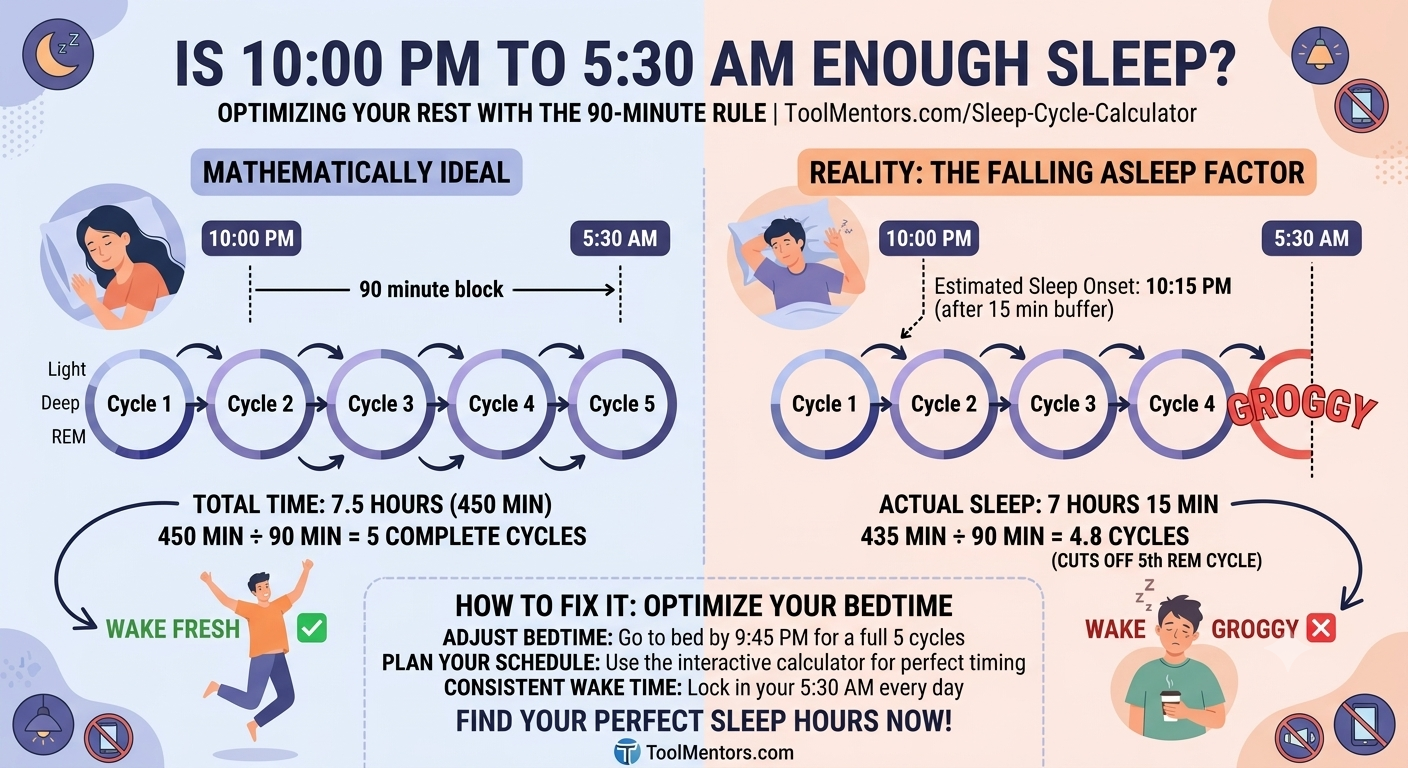
Human sleep doesn’t run on a continuous hourly clock; it runs in natural waves called sleep cycles. Each complete cycle lasts roughly 90 minutes and moves you through light sleep, deep sleep, and REM (dreaming) sleep.
Waking up at the end of a cycle makes you feel instantly alert. Waking up in the middle of deep sleep causes sleep inertia—that heavy, groggy feeling that makes you want to smash the snooze button.
Here is how the math breaks down for a 10:00 PM to 5:30 AM window:
-
Total Time in Bed: 7 hours and 30 minutes (450 minutes).
-
450 Minutes $\div$ 90 Minutes: Exactly 5 complete sleep cycles.
Because 7.5 hours divides perfectly into 90-minute blocks, this schedule is mathematically ideal for waking up refreshed.
The Catch: The “Falling Asleep” Factor
While the math is perfect, real life isn’t a calculator. Very few people close their eyes at 10:00 PM and instantly fall asleep.
On average, it takes a healthy adult about 15 minutes to drift off to sleep (a window known as sleep latency).
-
If you get into bed at 10:00 PM, you will likely fall asleep around 10:15 PM.
-
5 full cycles (7.5 hours) from 10:15 PM means your natural wake-up window is actually 5:45 AM.
-
If your alarm goes off at 5:30 AM, you are cutting your 5th sleep cycle short by 15 minutes—right during critical REM sleep.
How to Fix It
To get a true, uninterrupted 5 cycles by 5:30 AM, you need to adjust your bedtime slightly to account for the buffer. You should aim to be in bed and winding down by 9:45 PM.
Sleep Quality Breakdown
| Metrics | 10:00 PM to 5:30 AM | Adjusted: 9:45 PM to 5:30 AM |
| Time in Bed | 7.5 Hours | 7.75 Hours |
| Falling Asleep Buffer | 15 Minutes | 15 Minutes |
| Actual Sleep Duration | 7 Hours, 15 Minutes | 7 Hours, 30 Minutes |
| Completed Cycles | 4.8 Cycles (Groggy) ❌ | 5 Complete Cycles (Fresh) ✅ |
How to Optimize Your Specific Routine
If your work or lifestyle requires you to be up by 5:30 AM every morning, you can maximize your high-performance rest by following these steps:
-
Calculate Your Windows Instantly: Don’t do the mental math every night while you are tired. Use the customized digital tool on Tool Mentors Sleep Cycle Calculator to instantly plan your exact bedtime down to the minute based on real-time sleep metrics.
-
Keep the Weekend Consistent: Waking up at 5:30 AM on weekdays and sleeping in until 9:00 AM on weekends creates “social jetlag.” Try to keep your wake-up time within an hour of your normal routine on Saturdays and Sundays to keep your circadian rhythm locked in.
-
Control Your Light Exposure: To help your body wind down for a 9:45 PM or 10:00 PM bedtime, turn off bright overhead lights and blue screens by 9:00 PM. This signals your brain to start producing melatonin naturally.
FAQ: Quick Answers
Is 7.5 hours of sleep enough for an adult?
Yes, 7.5 hours represents exactly 5 sleep cycles, which falls perfectly within the National Sleep Foundation’s recommended 7-to-9-hour window for healthy adults.
Why do I still feel tired waking up at 5:30 AM?
If you went to bed at 10:00 PM and still feel exhausted, you likely experienced sleep disruption or took longer than 15 minutes to fall asleep, causing your alarm to interrupt a deep sleep phase. Using an interactive helper like the Sleep Calculator on ToolMentors can help you adjust your exact timings to prevent morning grogginess.